Showing posts with label WW1. Show all posts

Monday, 29 June 2020

Who was A Gibson? Where did he come from? Where did he live? I love a mystery!

I am trying to identify all of the men on the Brampton Parish Hall Roll of Honour (RoH) which was brought to my attention in February this year.  This is the latest of many posts I have written about the puzzles I have found along the way.  I have identified the majority of the men but I have a few who require more work.  Most of the men on the RoH have a full forename so when I only have an initial to go on the task is more difficult.

Snip of the Brampton RoH showing Gibson A.

My first clue to the identity of Gibson A. on the Brampton RoH was in a newspaper article dated 18 January 1915.  It was from the Sheffield Daily Telegraph and was found using Find My Past's newspaper search. Find My Past (FMP) shares the same newspaper resources as its sister site the British Newspaper Archive (BNA), which has a better search engine to be honest, but as that would be an extra subscription for me sometimes I search on the BNA and use the results to look for the newspaper on FMP.

Saw Sheffield Private Killed
Private Albert Gibson, of 40, Thomas Street, Swinton, of the 1st East Yorkshire Regiment, has just been invalided home suffering from rheumatism, the legacy of a long period of duty in the trenches up the waist in mud and water. He was at Mons acting with the reserves during the retreat. He first came into action on the Aisne, after forced marching for three days and three nights. It was in the early morning that they received the command to advance and capture some German trenches. This they accomplished, and then for seven days they were confined to the trenches "potting". His friend, Harry Ballard, of Attercliffe Road, Sheffield, who enlisted with him, was killed by his side in a charge the first Sunday after they came into action.  It was between two and three o'clock in the afternoon when they left their trenches in order to charge across a ploughed field, the German trenches being their objective. These, however they did not reach, and Ballard, when about in the middle of the field was killed, his body being almost riddled with bullets from a machine gun. In another charge Gibson saw Joe Allott, a Wombwell man, fatally wounded. Allott and he had worked together in Cortonwood Colliery. Gibson was in several bayonet charges which resulted in trenches being taken and retaken. Later he went to Armentiers, where in taking the enemy's trenches several prisoners were captured, including an officer.

There is a lot of detail here and I will pick out what I spotted that might help solve the riddle of Gibson A. on the Brampton RoH.
(1) Albert Gibson used to work at Cortonwood Colliery with Joe Allott.  I checked the list of names on the Cortonwood war memorial and found A. Gibson on the first panel of 'Men who joined H.M. Forces from the Cortonwood Colliery - there are three panels of men who survived the war and one of men who were killed. J. Allott is listed on the same panel as Gibson, and yet the cutting says Gibson saw him fatally wounded. Let's assume that this means Gibson survived the war - but be skeptical.
(2) Gibson was in the 1st East Yorkshire Regiment and was at Mons with the Reserves.  So he was a regular soldier called up from the Reserve - therefore I am looking for a man who enlisted before the war and who was awarded a 1914 Star.  We know he was in the Reserves, so he had served his seven years and was in his five year reserve period when war broke out. So he must have originally joined up before 1907, therefore he was probably born before 1889.
(3) The date of the article was 18 January 1915 and the action described was the Battle of the Aisne in September 1914 - I should look for the deaths of Harry Ballard and (maybe) Joe Allott around that time.
(4) Albert Gibson was living at 40 Thomas Street, Swinton when he enlisted. It is only four miles from Swinton to Cortonwood, so he may have lived in Swinton while working at Cortonwood Colliery.

Section of the Pension Card Ledger entry for Albert Gibson (WFA)

A likely candidate for Albert Gibson is Pte 7545 Albert Gibson of 1 East Yorkshire Regiment, entered a Theatre of War 8 September 1914 and discharged with a Silver War Badge on 23 September 1915 with sickness. His Pension Card Ledger on the Western Front Association (WFA) website gives his address as 29 Thomas Street, Swinton and suggests he was married but doesn't give the name of his wife. It looks as if a pension for 20% disability was being paid up to 1923 and appeals are noted in 1928 and 1932.  Albert Gibson's Silver War Badge card gives us the additional information that he enlisted on 15 September 1903, so proof that he was a regular soldier.  His seven years would have been up by 1910, but he could well have chosen to re-enlist for a while longer, some men did.

The 1st Battalion the East Yorkshire Regiment arrived in France on 10 September 1914. They were part of the 18th Brigade, 6th Division (Long, Long Trail). This Brigade was attached to I Corps under Haig for the actions on Aisne Heights, 20 September 1914 (Long, Long Trail).

Soldiers who were killed in the First World War are usually easier to find as there are more records online covering their commemoration and burial information.  I began with the Commonwealth War Graves Commission (CWGC) website, but despite there being 9 records for men who died from the United Kingdom called H* Ballard in the First World War none of them died in 1914 and none were in the East Yorkshire Regiment. Neither could I find Harry Ballard on the Sheffield Soldiers of the Great War website where I would expected him to be as the article quite clearly states he was from Sheffield. I searched for Harry Ballard in Soldiers Died in the Great War  (SDGW) on 'Ancestry' - nothing.  There were no other mentions in the Sheffield newspapers for this man, I would have expected an obituary or a death notice from his family in addition to the article above. It was time to try some variations on my searches.

On the CWGC website I searched for anyone in the East Yorkshire Regiment who was killed in September 1914.  That brought back 48 results. One was Henry Bolland, Pte 7796 1st Battalion East Yorkshire Regiment who died on 20 September 1914. This seems to be close enough, the right date, Bolland instead of Ballard  is understandable and Henry for Harry is no surprise.  His widow's address appeared to confirm my hopes. He had been married to Clarible (?) but by the time the CWGC records were collected she had remarried to a Micklethwaite and was living at 46, Birch Road, Attercliffe, Sheffield (Attercliffe is spelt Akercliffe on the website). He is remembered on the La Ferte-Sous-Jouarre Memorial in France so that means he has no known grave.  With this information I went back to my other resources. Sheffield Soldiers notes the same information that is on the CWGC site but adds that Henry was from Heeley in Sheffield and enlisted at Beverley, this extra information looks to have been taken from his SDGW record. He is remembered on the Sheffield Council Official Roll of Honour. 

We know that Joe Allott worked with Albert Gibson at Cortonwood so I decided to look for him in the same way I would look for one of the Brampton soldiers, starting with the census records. In the 1911 census Joseph Allott, aged 30, Coal Miner and Army Reservist (useful!) was living at 1 Inkerman, Jump, near Barnsley.  He had a wife, Harriett and two children Sarah Eliza aged 3 and John aged 1.  Joe was born in Hoyland in 1879 according to the 1881 census (although 1911 minus 30 gives us 1881) where he is living with his parents William and Sarah on St Helen's Street.  He had a younger brother George who may be the man listed on the Hoyland Roll of Honour and the postcard Roll of Honour for the Elsecar Midland Working Men's Club on St Helen's Street.  Interestingly there is no mention of a J. Allott on either of these memorials or the memorial at Jump. I found Joseph's pre-war Militia enlistment records on FMP - he had enlisted in the York and Lancaster Regiment in 1902 but was immediately transferred to the Artillery.

Section of the Pension Card Ledger entry for Joseph Allott (WFA)

Joseph Allott was quickly found in the Pension Cards on the WFA website.  He was Joseph Allott Gunner 27656 in the Royal Field Artillery and he was discharged on 2 November 1915. His address was the same as in the 1911 census. There are more details on his card - he was paid 12/- for himself and 8/10 for his wife in 1921 for a few weeks for a 30% disablilty, and then reduced to 8/- and 4/8 for a 20% disability until September 1923. There are dates up to 1932 on his card but notes OK and No Action in the later years.  So if this is the same man Albert saw being shot Joe was severely wounded enough to be discharged but happily he did survive the war. Which is as we suspected after seeing him remembered on one of the Men Who Served panels of the Cortonwood Colliery Memorial.

I could not find Albert Gibson in the 1901 or 1911 census returns in Swinton or anywhere else for that matter.  However a likely hit turned up in 1891 in Rotherham Workhouse aged 8 with a sister Jane and a brother Benjamin. All three were born in Swinton. I was able to find the birth registration of Albert Gibson Bailey in Q1 1884 in the Rotherham Registration District (RD).  Both Jane Ann (b.Q4 1881) and Benjamin (b.Q1 1883) were also registered as Gibson Bailey. In November 1884 Jane Ann Gibson and Benjamin Gibson were baptised at the Parish Church in Swinton (baptism records on FMP).  Their parents were John and Ada Gibson of Swinton. John was a Glass Blower.  Oddly Benjamin and Albert were baptised again in 1898, this time from the Workhouse - their birthdates were given as 8 August 1883 and 23 December 1884 respectively.  Sadly Benjamin died in 1900 aged 17 in the Workhouse, but in the residence box someone has helpfully added 'formerly Bow Broom', which is an area of Swinton including Thomas Street where Albert Gibson lived before the war.  Just imagine, Benjamin was baptised aged 14 and died aged 17 - this suggests to me that he was sickly as surely they would have tried to find work for him before that?
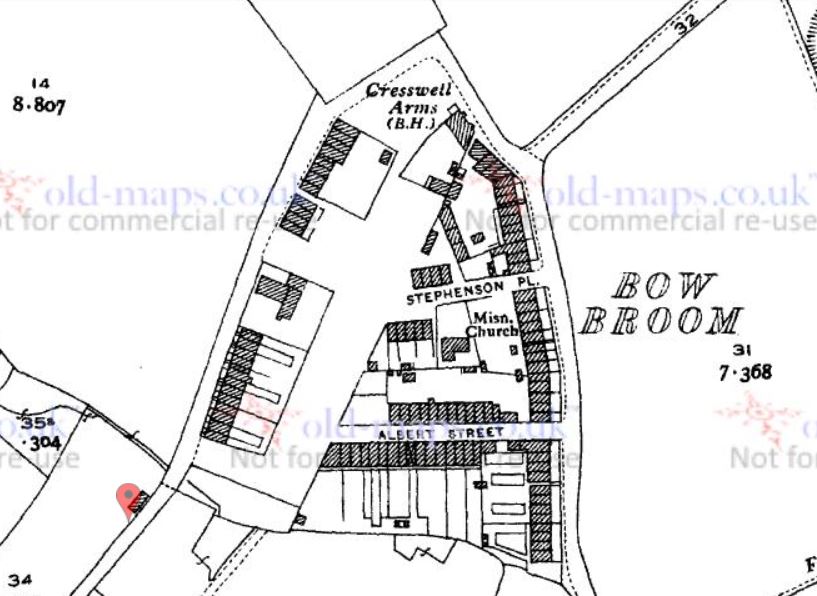
Snip from the 1930 Ordnance Survey map for Swinton showing Bow Broom
The road running top to bottom on the left is Thomas Street (from Old Maps)

This map snip shows the Bow Broom area of Swinton and the houses on Thomas Street. A later map includes the numbers and so I know that the lowest house shown here is number 40 and that the numbers run contiguously from north to south, not odds on one side and evens on the other.

I was able to find John and Ada in the 1881 census living at 8 William Street in Swinton. John was from Sunderland (which was an exciting moment as I was born in Sunderland!) and Ada was from Adwick, Yorkshire.  There is no record of them ever having married, which is no doubt the reason for their children being registered as Gibson Bailey.  Ada appears to have been a bit of a character appearing in court reports in the local newspapers in 1882 and 1886; on both occasions it was for fighting with another woman after a quarrel.  In the latter report Ada is Rotherham Workhouse, so we can assume that her children had been there from at least that date. There is no further sign of John Gibson but Ada Bailey married John Bloore in Q1 1891 (while her children were in the Workhouse!) and in the 1891 census return (5 April 1891) she is living with him at 16 Hicks Square, Glasshouse Road, Kilnhurst, near Rotherham and only two miles from Swinton. They already have one child, Harriet Ann aged 1 born in Kilnhurst. I am 100% certain this is the same woman as she gives her place of birth as Adwick and Harriet Ann's mother's maiden name is given as Bailey in her birth registration Q1 1890 in Rotherham RD.  I can find only one Ada Bailey of the right age born in 1862 in Adwick upon Dearne, to Charles and Emma Bailey.

Ada and John Bloor (also Bloore, Blower and Blewer) were living in Denaby Main at the time of the 1901 census by which time Sarah Ann, Polly and Mary had come along to join Harriett. Ada Bloor(e) continues to have an interesting life. She appears in the Mexborough and Swinton Times on 4 March 1905 accusing another woman of using obscene language towards her.

Obscene Language at Denaby Main
A lady who rejoices in the somewhat ill-fitting cognomen of Matilda Spruce, and who is described as a married woman, of Denaby, was summoned by another lady, by name Ada Bloore, for using obscene language towards her, on 21st February. The complainant stated that the defendant was always calling her filthy names, and that she wanted a stop putting to it. Defendant denied the insinuation that she used filthy language, stating that she was a respectable women. The Bench dismissed the case, whereupon the defendant, who only restrained her evident surprise and glee as "having won the day", with difficulty said: "Thank you sir, have I anything to pay?"  Upon being informed she could go, the defendant excitedly waved her "fur boa" in the air and exclaimed: "Three cheers", and merrily bounced out of court.

Despite her abandonment of her first three children in the workhouse (presumably after her desertion by John Gibson) I had hoped Ada found some happiness with John Bloor. Sadly it was not to be as he died in 1907 and by 1911 Ada is living with a John Hegin on Manningham Road in Attercliffe, Sheffield. This is definitely the right woman as the Hegins have Polly and Mary Blower living with them and Harriett Ann and Sarah Ann Blower are listed and then crossed out, all as step daughters - presumably because Ada gave her older girls names to the person who filled the schedule in for her (she signs with a x) before telling them that the two oldest were not living with her at that time.  Again I can find no sign of a marriage for Ada Bloor or Bailey to a John Hegin, but as the form was filled in by someone else and Ada was illiterate Hegin may be just as poor an intepretation of what was said at the time as Blower was for Bloor.

Having digressed to follow Ada around Yorkshire I must get back to Albert Gibson as he was the orignal object of this post.

In the 1918 Electoral Register an Albert Gibson is living at 39 Thomas Street in Swinton which is obviously very close to number 40, the address given in the newspaper article I first found. There are three other men at the address, Frank Arthur Waite, Leonard Hanking and William Abbott, although Abbott is marked as an Absent Voter in the Forces.  Albert is at the same address every year up to and including 1934, with various other occupants. In 1920 Grace Mary Abbott is listed there but no sign of  William Abbot, but Albert Gibson, Frank Arthur Waite, Leonard Hanking are there plus two other men. Grace Mary Abbott is still at 39 Thomas Street with Albert Gibson in 1934 and so is Frank Arthur Waite, now joined by Ethel Waite.  Albert would have been 50 years old by this time.

Section of 1939 Register for 39 Thomas Street, Swinton (from FMP)

Of course this turns out to have been all too simple ... at the same address in the 1939 Register I found Grace M Abbott apparently born 29 November 1852 and Albert Gibson born 22 November 1917!  There are two redacted names between these two people.  This cannot be the same Albert Gibson named in 1918 - he would have only been 1 year old!  And the birth day and month do not match that given in his workhouse baptism record. Is this a mistake? or his son? or a complete co-incidence?

1911 census for 40 Thomas Street, Swinton (edited to save space)

If Grace Abbott was indeed born in 1852 that made her 87 years old in 1939, which seemed a good age, so I thought I would investigate her.  Jackpot! In the 1911 census William and Grace Mary Abbott are living at 40 Thomas Street, Swinton, the very address Albert Gibson gives in the newspaper report in 1915. Grace Mary Abbott gives her age 57, which is within two years of the birth year of 1852 she reported in 1939. William and Grace say they had been married for 40 years and reported twelve (!) children to their marriage, of whom eight were still living in 1911. Only two of their children were still at home when the census was taken, but they also had two nephews living with them.

It seemed that despite the smallness of the house, with only four rooms declared, they managed to fit six people in somehow. This obviously continued for many years, but boarders/lodgers replaced children and nephews. An Albert Gibson appears to have lodged with them for many years, and Albert Gibson the soldier says he lived at 40 Thomas Street, but whether, over the years, it was the same man or two men with the same name, has not been demonstrated yet. 

One thing that may make sense is that the William Abbott who was an Absent Voter in the 1918 Electoral Register was probably the William Abbott jnr listed on the 1911 census as 13 years old.  I have mentioned before men aged 19 and over and in the Forces were also able to vote in 1918, so William jnr at 20 would have been listed.

For the sake of completness and with my fingers crossed I checked the 1901 census for Thomas Street. William and Grace Abbott are at 38 Thomas Street with five children. Grace gives her age as 48 years, that is born in 1852/3 in agreement with the 1939 Register.  William said he was 50 years old, but in 1911 he gave his age as 65.   That would have made him 72 years old in 1918, defintely too old to have been in the Services as an Absent Voter.

Remember this for later ... Jonathan Abbott aged 23 born in Normanton near Wakefield is living at 40 Thomas Street just two doors away.

It took a couple of looks for me to spot something strange ... in the 1901 census William and Grace's children are listed out of order and there is someone missing.  (in the lists below 'Do' means ditto)

William Abbott    Head    Married     M    50    
Grace M     Do     Wife    Married     F    48
Harriett       Do    Dau       Single        F    18
Sarah Jane    Do    Dau    Single        F    13
Albert         Do    Son      Single        M    19  (which has been over written in very heavy ink)
Hannah L    Do    Dau    Single        F    11
Edith L        Do    Dau    Single        F    8

I looked back at the 1891 census entry for the same family and found them at 38 Thomas Street in Swinton.

William Abbott    Head    Married    M    44
Grace     Do        Wife    Married    F    37
Thomas    Do       Son    Single    M    15
Jonathan    Do    Son    Single    M    13
Francis    Do        Dau    Single    F    10
Harriett    Do        Dau    Single    F    7
Grace        Do    Dau    Single    F    5
Sarah Jane    Do    Dau    Single    F    3
Amelia Eliza   Do    Dau    Single    F    1

Can you spot the difference?
(1) Where is Albert aged 9 in 1891?  If Albert is actually 10 in 1901 which would better fit the placing in the list, why has it been heavily written over as 19 to emphasise it?
(2) Where is William Abbott jnr in 1901, if he was 13 in 1911 he should be 3 in 1901?

I should comment on one of the girl's names - Amelia Eliza in 1891 becomes Hannah L in 1901 - that could just be transcription and enumerator error.

And look ... Jonathan Abbot who was living two doors away in 1901 is the right age to be their son shown as 13 in 1891 and ... both were born in Normanton. So by 1901 the Abbott family were occupying two houses, numbers 38 and 40.

I went back to check 1911.  The name of the person who filled in William and Grace's census form was Albert Edward Cook, he also filled in the census form for the house two doors away, where he appeared at the top of the schedule as 'Nephew' not the head of the household ... and this house was apparently also 40 Thomas Street!  A closer look suggests that actually William and Grace were living at number 38 according to the address information on the page following their return and number 40 was occupied by six men, four nephews and two boarders with, as we have noted, no head of household indicated. The name given on the address information was also W. Abbott. So the Abbott family was still occupying both houses and number 40 - the real number 40 was being used as a kind of lodging house.

Back to Albert ...
 
I hoped I wasn't on a wild goose chase ... but maybe William and Grace took Albert Gibson in as a lodger when he left the workhouse and the enumerator mistakenly listed him as their son in 1901. He wasn't have been living with them, in either house, in 1911, maybe because he had joined the army in 1903 and stayed on a bit longer than his seven years, but it seems to fit that in 1915 he gives the address of their second house, the lodging house, 40 Thomas Street as his home.

I needed to check William and Grace's children on the General Register Office (GRO) online index of births. I prefer to do this on the GRO because mother's maiden names are not recorded before 1911 on the FreeBMD or Ancestry indexes.

Let's take Harriett Abbott, she's in both census returns.
Born 1883 or 1884 in Bolton upon Dearne (which would be in the Doncaster RD)
Abbott, Harriet Robertson [mmn] Robertson
GRO Reference: 1883 J Quarter in Doncaster Volume 09C Page 722

Ok, now Sarah Jane Abbott, born 1888 in Swinton (which would be in the Rotherham RD)
Abbott, Sarah Jane [mmn] Robertson
GRO Reference: 1888 M Quarter in Rotherham Volume 09C 654

We have established that Grace Mary's maiden name was Robertson, and sure enough on FreeBMD I found the marriage of Grace Mary Robertson to William Abbott in the December Quarter (Q4) of 1872 in the Pontefract RD.  That makes Grace Mary Robertson 20 years old when she marries William, a very reasonable age.

Here's the crunch ... is there an Albert born to this family, surname Abbott mmn Robertson in either 1882 or 1891. This is what I found.

Tamar Howarth Abbott b.Q3 1872 in Pontefract
William Oath Abbott b. Q3 1874 in Pontefract
Thomas Robertson Hoult Abbott b.Q2 1876 in Pontefract
Jonathan Robertson Abbott b.Q2 1878 in Wakefield
Frances Tamar Abbott b.Q4 1880 in Barnsley Union
Harriet Robertson Abbott b.Q2 1883 in Doncaster
John William Abbott b.Q1 1885 in Rotherham
Grace Ann Abbott b.Q1 1886 in Rotherham
Sarah Jane Abbott b.Q1 1888 in Rotherham
Hannah Eliza Abbott b.Q2 1890 in Rotherham
Edith Elizabeth Abbott b.Q3 1893 in Rotherham

Eleven children born to William and Grace Mary Abbott - not the twelve they declare in 1911, but sometimes people counted miscarriages. No Albert! And no William Abbot jnr born in 1898.  We will never know for certain but it does look as if Albert Gibson could have been living with William and Grace Mary Abbott at 38 Thomas Street in 1901 and later in the other house they owned, the lodging house at 40 Thomas Street two doors away. 

When a stray child like William Abbott jnr turns up in the household of an older couple one common reason is that they have taken in a grandchild by a daughter to help her out. 

I haven't found deaths for Albert Gibson, or Ada Hugin/Bloor/Gibson/Bailey yet so their stories are not completely finished, but that is enough for today.  This has turned  into a mega post!

Thanks for reading.

References:
1939 Register, Find My Past, https://search.findmypast.co.uk/search-world-Records/1939-register, accessed 28 June 2020.
British Newspapers, Find My Past, https://search.findmypast.co.uk/search/british-newspapers, accessed 28 June 2020.
Commonwealth War Graves Commission, https://www.cwgc.org/, accessed 28 June 2020.
General Register Office, Online ordering service, https://www.gro.gov.uk/gro/content/certificates/Login.asp, accessed 28 June 2020.
Long, Long Trail, 'Enlisting into the army', https://www.longlongtrail.co.uk/soldiers/a-soldiers-life-1914-1918/enlisting-into-the-army/, accessed 28 June 2020.
Pension Records, Western Front Association, https://www.westernfrontassociation.com/ancestry-pension-records, accessed 28 June 2020.
Sheffield Soldiers of the Great War, http://sheffieldsoldierww1.co.uk/Home.html, accessed 28 June 2020.
UK, Soldiers Died in the Great War, Ancestry, https://www.ancestry.co.uk/search/collections/1543/, accessed 16 June 2020.

Tuesday, 16 June 2020

James and Albert Crawford First World War Soldiers from Concrete, Brampton

The section of the Brampton RoH showing James Crawford's name

I have been investigating the Brampton Roll of Honour which hangs in Brampton's Parish Hall since February this year. For briefness I will refer to it as the Brampton RoH or just the RoH.

There are 100 names listed on the RoH, 22 of these men (and they are all men) were killed in the First World War, the others survived to return home to their families.  I have found census data allowing me to establish who these men were and where they lived for 91 of these names and military information for 73, an increase of one since my last post. 

I have also begun to collect a list of men from the area covered by this memorial, ie the Concrete Cottages and Wath Junction, who served in the war but who were not listed on the RoH.  There were three additional names on the Cortonwood Wesleyan Methodist Roll of Honour (found online) which are not on the Brampton RoH, 29 more men were marked as Absent Voters in the 1918 Electoral Roll for Brampton or Wombwell South (the wards which include Concrete and the Junction and which available on Ancestry.co.uk) and three more have been found (so far) in the local newspaper, the Mexborough and Swinton Times (MST).

The Mexborough and Swinton Times was added to the British Newspaper Archive this month, June 2020 (also available on sister site Find My Past). It covers the southern part of Barnsley including Wombwell, Great Houghton, Thurnscoe (all within the modern Barnsley boundaries) plus Brampton, Wath, Swinton, Mexborough and Conisbrough. In the last two days, purely with a search on the word 'Concrete' I have added three more names to my research list, including one man from Concrete, George Clark, who was killed.

One odd thing about these additional names is that they include men who are the brothers of men who are listed on the Brampton RoH. We could suggest a couple of reasons for this, maybe they moved away from the area before the list was compiled? Possibly so, but many of the men listed on the RoH, despite living in Concrete earlier in their lives, were already living away from the area in 1911.  Maybe their families did not want them included - which is strange if one brother is listed but not another.

James and Albert's names on the Cortonwood Wesleyan RoH

For this post I am focusing on James (b.1896) and Albert (b.1891) Crawford, brothers who were both killed in the war. James Crawford is named on the Brampton RoH, Albert Crawford is not, but I had found him on the Cortonwood Wesleyan RoH alongside his brother.

They were living at home, 11 Wath Road, Wombwell Junction, with their parents James snr and Emily Crawford in 1911. Also listed on the census return is another brother, William (b.1893) and a sister Rose (b.1901). The return states that Emily has been married for 20 years and has had five children, one of whom had died before 1911. A search of the General Register Office (GRO) indexes tells us that Ann Crawford was born in 1895 and died the same year. These searches can be carried out in five year chunks using a surname and mother's maiden name. They are very useful for discovering the absent children that the 1911 census additional information tells us about. According to the census only Rose was born in Wombwell, the other children having all been born in Worsborough Dale.

James Crawford snr and Emily Pickard had married in Worsborough Dale (the second 'o' was lost from the area name in the early to mid 20th century), about five miles from Wath Junction, on 31 December 1890. James was originally from Thirsk, North Yorkshire and Emily from Otley, West Yorkshire (according to the 1901 and 1911 census returns), although in the 1891 census when James and Emily were living with her parents in Worsborough Dale, all her family (including James Crawford) are listed as being from Worsborough Dale itself.  This is an error as the 1881 census tells us that Emily's father William Pickard was from Otley, her mother Hannah from Darfield, Emily and Samuel, the older of three children, from Otley and Herbert, the youngest child, from Darfield. So the family moved around quite a bit, Otley being about 44 miles from Darfield.  It is always best to cross-check information found on a source as transcriptions or information given to the census enumerators or even to clergy for marriages, baptisms or burials can often be in error.

The Cortonwood Wesleyan RoH helpfully tells us that James was in the K.R.Rif., the King's Royal Rifle Corps, and gives us his Service number 467. This information tallies with his Service Records which have fortunately survived (60% of these records were destroyed in the blitz during the Second World War) and his entries on Soldiers Died in the Great War (SDGW) and the Commonwealth War Graves Commission (CWGC) website. He was killed on 18 June 1916 and his CWGC entry confirms that his father was James Crawford, of 11 Wath Road, Wombwell, Barnsley and that he was buried in the Cambrin Military Cemetery in France. His SDGW entry adds that he was killed in action and that he was born in Wombwell - which is therefore in disagreement with the 1911 census return. The information about his regiment reminded me of another memorial in Wombwell - the Church Lads Brigade memorial in St Mary's Church which was affiliated to the King's Royal Rifle Corps. Sure enough a Crawford, J. is listed there as well. He is also listed on the Wombwell Reform Club Members RoH in the Killed in Action section at the top alongside a Crawford, A. Pte. Y.L.

Two Crawford men named on the Wombwell Reform Club RoH

According to the Cortonwood Wesleyan RoH Albert was in the R.N. Lanc. Regt., Service number 31329. Tracing Albert's records was more complicated. His CWGC entry tells us that he was in the Loyal North Lancashire Regiment Service number 42151 (could someone have confused Loyal with Royal when preparing the Cortonwood RoH?) - this is the correct man as his parents are listed as Mr and Mrs J Crawford of 11 Wath Road, Wombwell. We also discover from this record that Albert was married, to a Mabel F. Crawford, and that her address at the time the CWGC information was collected was 4 Hough Lane, Wombwell. Bear in mind that the addresses for widows do not necessarily reflect the place where a soldier lived before he enlisted. Widows often moved after a man's death, maybe to return to their parents' home, or after re-marriage. Albert's SDGW entry adds that he was formerly in the York and Lancaster Regiment Service number 44591 and that he was born in Worsboro' Dale - which is correct according to the 1911 census return. He was killed on 4 November 1918 and was buried in the Mazinghien Communal Cemetery in France. Interestingly the additional documents on the CWGC page for Albert Crawford include a Graves Registration form which tell us that he was one of eleven Loyal North Lancs men killed on that day buried in that cemetery which suggests that a significant action had taken place (in my opinion). There seems to have been some confusion about his identity at some point as the type written entry reads 42151 Crawfers Pte.A. which is overwritten in ink, 44591 Crawford. Note that this is his Y&L Service number!

Graves Registration for Mazinghien Communal Cemetery CWGC

Now having the information that Albert had initially served in the York and Lancaster Regiment the Wombwell Reform Club entry makes sense.  Both James and Albert are also listed on the main Wombwell memorial outside St Mary's church - but as these names were renewed and updated in the last 10 or 20 years (see a photo from the 1930s on the Yococo website) it cannot be ruled out that they were added during the update.

Albert Crawford and Mabel Florence Hazzard had married on 23 May 1918 at Wombwell Parish Church and that record states his occupation is miner. So when did he join the Army? If it was after their marriage he was not long in the forces before he was killed. Barely enough time for initial training compared to the men who enlisted earlier in the war. After his death two death notices appear in the Mexborough and Swinton Times (MST) on 23 November 1918, one from Mabel and one which names his parents, James and Emily, giving their address at 11 Wath Road. Albert's photograph appears in the newspaper the following week, although it gives his regiment as the York and Lancaster, despite the death notice the week before more accurately reporting him in the Loyal North Lancs.

Albert and Mabel do not appear to have had any children. Mabel remarried in the September quarter of 1923 to Samuel Wardell (according to FreeBMD) and bore him two children, Albert in Q3 1924 and Mabel in Q4 1926. It is touching to see that her first child was named after her previous husband. In the 1939 Register the couple were living at 25 Cemetery Road in Wombwell with Albert and a redacted entry, probably young Mabel. In the comments column at the far right it was noted that Samuel was an Air Raid Warden.

Albert Crawford's Pension Card from the WFA website

So why was Albert not included on the Brampton RoH?  It could be that his wife Mabel did not know about the RoH or did not want him included. It could be that at the time of the compilation of the memorial there was some uncertainty about Albert's death.  However Albert's Pension Card (on the Western Front Association website and also available via Fold3 on Ancestry) states that his death was notified on 27 November 1918 which is not a long delay. This tallies with the date of the death notices published in the MST on 23 November.  On the Pension card Mabel's address has been changed from 4 Hough Lane, Wombwell (the address we saw above on the CWGC entry and the address from which she married in May 1918) to Laurel Dene, Lepton, Huddersfield so maybe she was living away from home for a while (there is no mention of her second marriage on the card). But why would his parents James snr and Emily omit him? It seems unlikely that a list of 100 men was compiled as soon as the Armistice was announced - and that the news of Albert's death came too late for him to be added. Could it be because he enlisted so late? Was the RoH compiled before his enlistment?

James and Albert are listed side by side on the Cortonwood Wesleyan Methodist RoH and the Wombwell Reform Club RoH but not on the Brampton RoH. And what happened to their brother William (b.1893), he was the right age to have served in the war and but I have found no military records for him yet. More questions that require further research if I am ever to understand this document.

William Crawford married Winifred Carr in Q3 1918 and I have found them in the 1939 register. They had two children, Albert b.1920 (another named after the Albert who died in the war?) and Joan b.1923. I have also found them in the 1939 register living in Hemingfield near Wombwell. William dies just two years later from the same address 16 Garden Grove, aged just 48. He predeceases his parents James snr, who dies in 1945 and Emily, who dies in 1948. They are buried in adjacent plots in Wombwell Cemetery. Sadly whilst searching in the Cemetery records I discovered that Rose Crawford who had married Lionel Hawksworth in Q1 1919 died in January 1922 and was buried from 11 Wath Road, her parents' home. This means that James snr and Emily outlived all their children.  The only consolation that I can find is that Rose gave birth to a daughter, Bessie, in 1920, who in 1939 is married and living with her widowed father and his mother in Wombwell. 

I have not yet confirmed which organisation compiled the Brampton RoH or when it was drawn up. It was apparently discovered in a poor state in the papers of a Brampton Parish Clerk as he handed over to a new incumbent very recently.  The discovery of the document was reported in October 2018 in the local parish council magazine where it was also noted that the former Parish Clerk had retired on 31 March 2018 after 32 years service!  So the RoH had been hidden away for many years.

Thank you for reading.

References:

1939 Register, Find My Past, https://search.findmypast.co.uk/search-world-Records/1939-register, accessed 16 June 2020.
British Army Service Records, Ancestry, https://www.ancestry.co.uk/search/collections/1219/, accessed 17 February 2020.
Census returns, Ancestry, https://www.ancestry.co.uk/search/categories/ukicen/, accessed various in February - June 2020.
Commonwealth War Graves Commission, https://www.cwgc.org/, accessed 16 June 2020.
Cortonwood Wesleyan Methodist Roll of Honour, My Methodist History, https://www.mymethodisthistory.org.uk/topics-2/war_memorials/a_further_204_late_returns/cortonwood, accessed 9 March 2020.
General Register Office, Online Ordering Service, https://www.gro.gov.uk/gro/content/certificates/login.asp, accessed 16 June 2020.
Mexborough and Swinton Times, British Newspaper Archive, https://www.britishnewspaperarchive.co.uk/titles/mexborough-&-swinton-times, accessed 15 June 2020.
Parish News, Issue 21, October 2018, Brampton Bierlow Parish Council, https://www.bramptonbierlow-pc.gov.uk/sites/default/files/pdf_docs/brampton_bierlow_oct_18_3_0.pdf, accessed 16 June 2020.
Parish Records for Worsborough Dale, Yorkshire Marriages, Find My Past, https://search.findmypast.co.uk/search-world-Records/yorkshire-marriages, accessed 16 June 2020.
Pension Records, Western Front Association, https://www.westernfrontassociation.com/ancestry-pension-records/, accessed 16 June 2020.
UK, Soldiers Died in the Great War, Ancestry, https://www.ancestry.co.uk/search/collections/1543/, accessed 16 June 2020.
West Yorkshire, England, Electoral Registers, 1840-1962, Ancestry, https://www.ancestry.co.uk/search/collections/3057/ accessed 22-28 May 2020.
Yococo Image Database, Barnsley Council Online, https://wwwapplications.barnsley.gov.uk/librarydigitisation/details.aspx?imageID=2755 accessed 16 June 2020.


Saturday, 28 March 2020

Distant connection - the Brampton Parish Hall Roll of Honour

It was bound to happen eventually ... I have found a connection between some of the men named on the Brampton Parish Hall Roll of Honour and my husband (aka the OH).  As I have been researching the OH's family history for the past twenty years or so I have come to realise that Barnsley really isn't that big a place. If your family has a line that stretches back two hundred years in the area, just beyond the census returns and into the realms of the parish records being the best available sources, there is a very good chance that you are connected to everyone else in the area who has equally long lines.

Quite a few years ago now I discovered that the OH's father and one of his best friends, who had for many years, with their wives, been accustomed to taking Tuesday nights off and going out for a drink together, were fifth cousins. I have shown that the OH is related to a number of his own friends, admittedly in some cases with marriage links rather than blood lines, and using the OH as an intermediary one of my BWMP (Barnsley War Memorials Project) colleagues was related to her husband!  These connections are usually via the OH's paternal grandmother Mary Blackburn; I have determined that thirteen of her great-grandparents (out of a possible sixteen) were born in the Barnsley area between 1800 and 1831. In comparison, on his mother's side not a single one of her great-grand parents were born in Barnsley!

Cropped section of the Brampton Parish Hall RoH
showing Joseph and Walter Savage's names
The connection with the Savage family is via a marriage link. In 1957 the OH's great aunt married into the Savages, a family who have been in Barnsley since about 1819.  George Savage, born 1767, his wife Mary and at least three of their eight children (that I am aware of) moved to Barnsley in time for the birth of their youngest son Joseph in 1819. They had previously lived in Newark in Nottinghamshire and George, head of the family, was a weaver. The OH's connection descends from that Joseph Savage born in Barnsley in 1819 and the two brothers on the Brampton Parish Hall Roll of Honour descend from his older brother, George Savage, born in Newark in 1806.

A short history of the Savage family by Vivian Thomas can be found in Moving Lives: Stories of Barnsley Families (Barnsley Family History Society, 2007). Vivian is the granddaughter of Walter Savage who was listed on the Roll of Honour and her article includes a photo of Walter in uniform. I confess that I have only just noticed this, my only excuse is that I bought the book years before I really started researching the OH's First World War relatives.

I have been researching the names on the Brampton Parish Hall Roll of Honour since the beginning of February. At a rate of one or two men a day, and with a hundred names on the list, it is not a quick job! Yesterday I reached Joseph and Walter Savage. I did wonder about them as Savage is not a common name in Barnsley, but with them being in Brampton I didn't immediately assume there was a connection to the Barnsley family I knew were related to my husband.

1911 census for 6 Wath Road, New Wombwell (from Ancestry)
My first search was in the 1911 census where I found the two men, obviously brothers, living at 6 Wath Road, New Wombwell, with their father George, mother Mary Jane and two other siblings, Charles and Sarah. The address is in the vicinity of most of the others I have traced on the Roll of Honour and therefore I accepted that I had found the correct men.  In a previous post I explain how most the men named (that I have researched so far) appear to come from a small area around the Concrete Cottages and Wombwell Junction.

I noticed that George Savage, the father of the assumed soldiers, was born in Barnsley in 1866, and my suspicions were aroused. It was fairly easy to find his marriage to Mary Jane Skiffington at St George's Church in Barnsley in 1886 on Ancestry and I saw that both he and his father Charles Savage were described as Publicans. I remembered that the Savages in the OH's family tree had run a few pubs so I tracked back one more generation. Charles Savage married Sarah Naylor at St George's Church in Barnsley in 1864 and his father was George Savage 'Inspector of Nuisances'. Yes, they were connected to the OH!  I wrote a post about the family in 2013.

1891 census for 1 and 2 Wombwell Junction, Guide Post Inn (from Ancestry)
In 1891 Charles Savage was running the Guide Post Inn at Wombwell Junction. George, his son, already married to Jane (aka Mary Jane), was still living in his father's household along with his sons Charles and Walter.  Charles had previously run the Melbourne Hotel on Sheffield Road in Barnsley which is where I found him and his family in the 1881 census.

1905 map snip of the Wombwell Junction area
(from National Library of Scotland)
Vivian Thompson, in her article in Moving Lives, refers to the triangle of houses with the Guide Post Inn at the apex (see map on left) as 'the three cornered hell' which seems a little harsh. She does not explain from where she got this term.

There is a picture of the pub on the Old Pictures of Barnsley Facebook site which probably dates from the 1960s as the houses behind it appear to have been demolished. In several of the comments attached to the picture the term 'three cornered hell' is also mentioned.

Walter Savage enlisted in the Royal Artillery in 1909 giving his address as 6 Wath Road, Wombwell and his occupation as Colliery Trammer. His place of birth was New Wombwell, which I have noticed is the term used for the area covered by the Junction and the Concrete Cottages.

You might have spotted that in 1911 he is listed as a Soldier in his father's census return. As George also includes a deceased child, Tom Savage, he appeared to interpret the census instructions very broadly, including all his children whether at home or not, so the presence of Walter on the return does not mean that he was living at home in 1911.

A further search of the 1911 census, now that I know Walter had enlisted in 1909, uncovered him in Kirkee, India (now known as Khadki) in an army barracks with the 81st Battery, Royal Field Artillery. Some information on the 81st Battery and the 5th Brigade of which it was part can be found on the Long, Long Trail website.  Walter's Medal Card, service number 54143, informs us that he reached a theatre of war (unspecified, so it could be Egypt or France) on 6 November 1914, which qualifies him for the 1914 Star. His rank was Gunner.  The Barnsley Chronicle on 13 November 1915 reports that he had a brief return home to Wombwell.
Corporal Walter Savage, R.F.A., on Wednesday, made an unexpected re-appearance amongst his family and friends at Wombwell Junction, Wombwell, after being absent for over six years. At the outbreak of war Savage was serving in India. The regiment was recalled after the outbreak of war, and he was drafted to France in October without having the pleasure of paying a visit to his home. He has seen a great deal of heavy fighting, but, fortunately, so far has received no injury. He was given a great reception by his old friends. Savage was once prominent in local football circles.
He was discharged on 1 January 1921 and the address he gave at that point was 74 Hawes Side Lane, Blackpool.  He had married Faith Hope Charity Pearson (lovely name!) on 24 December 1920 at Marton in Lancashire, presumably whilst on his final leave from the army. Marton is now a suburb of Blackpool and is very close to Hawes Side Lane. By 1939 he had moved around the corner to Powell Avenue. Walter and Charity (Vivian refers to her by this name) appear to have only had one child, Alice born in 1922 in Wombwell oddly enough.

Joe Savage, Walter's younger brother, enlists into the Territorial Force in June 1915 and joins the (West Riding) Royal Horse Artillery, service numbers 4050 and 831644. Joe's Service Records have survived and can be viewed on Ancestry and Find My Past. He was a tall man for the time, 5 feet 11.75 inches and with a 38 inch chest. He gives his father's address as 6 New Wombwell, but I assume this is the same as 6 Wath Road. He lands in France on 23 May 1916 and is wounded in the right leg in September 1917, but this does not appear to cause any lasting disability.  He was discharged on 13 March 1919 and gives his address as 6 Wath Road, New Wombwell. He marries Nellie Count on 21 September 1919 at St Mary's Church in Wombwell. They have three children, Betty who dies young, Jessie and George. In 1939 the family is living at 80 Wath Road in Wombwell. Joseph is listed as a Licensee - but of which pub?  Vivian's article helps again telling us that the Guide Post Inn was run by three generations of the family (although not continuously), Charles, George and Joseph before its closure in 1968.  Joseph apparently ran it for 38 years!

It is always nice to link the OH to pubs as he is a longstanding member of the Campaign for Real Ale (Barnsley Branch). But he hadn't heard of the Guide Post Inn before so I look forward to telling him his tenuous connection.

Thank you for reading.

Wednesday, 11 March 2020

Four brothers Moorhouse from the Concrete Cottages in Brampton who Served in the First World War

There are 100 names on the Brampton Parish Hall Roll of Honour and the men appear to have come from a small community focused on the 106 Concrete Cottages which were on the boundary of Brampton and Wombwell [now] in South Yorkshire.

Now that I am about halfway through the list, having reached 'M' for Moorhouse a few days ago, I have discovered that the connections of the men with the area are sometimes more obscure - but in every case I have researched, at some point, the man or his family have lived in either the Concrete Cottages or on Wath or Brampton Roads nearby. The families sometimes intermarried and brothers, cousins and in-laws have been remembered together.


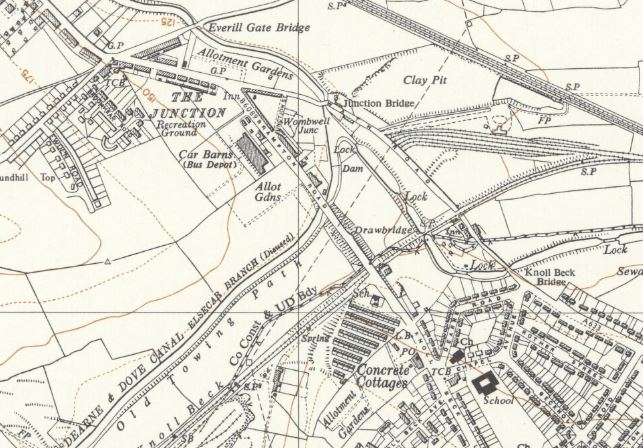
1930 amended 1955 map of The Junction and Concrete Cottages.
From the National Library of Scotland.
This map from 1955 shows the Concrete Cottages. Compared to the 1907 map in my first  post about researching the names the school and chapel have moved south down Knoll Beck Lane. I know that the cottages were built in 1876 for Cortonwood Colliery, and judging by an Ordnance Survey map from 1964 available on the National Library of Scotland's website they had disappeared by the 1960s and been replaced by Garden Drive, which according to Street View on Google Maps is a street of council style bungalows and houses.  An aerial photograph dated 1958 published in the 'Barnsley Memories' magazine for Winter 2007 appears to show the Concrete Cottages partially demolished.

It would be interesting to discover whether the people from Concrete Cottages were rehoused locally and if anyone can remember them or indeed used to live there.

In my last post I discussed the possible origin of the Roll of Honour. I am satisfied that it was not a Cortonwood Colliery related document, but it may be connected to the Methodist Chapel or school associated with the Concrete Cottages. Someone who used to live in the area might know the origin of the Roll of Honour - or even have donated it to the Parish Hall.

The Four Brothers Moorhouse

Four men named Moorhouse on the Brampton RoH
The Roll of Honour lists four men with the surname Moorhouse.  I suspected that it was possible they might be brothers, but now my research has proven that this was indeed the case. Sydney Moorhouse b.1881, William Moorhouse b.1882, both born in the Wakefield area and their brothers John Moorhouse b.1892 and Henry Dean Moorhouse b.1894 were born in West Melton, were four of the sons of George and Julia Moorhouse who had married in 1880 in Wakefield. The family lived at 49 Concrete Cottages in 1891 and 46 Concrete Cottages in 1901. That, in itself, suggests that John and Henry were actually born in the cottages. 
1901 census snip for 46 Concrete Cottages (from Ancestry)
The family included another son confusingly also called Henry in the 1901 census. He was born in 1884 in the Bramley near Leeds and registered and baptised as Harry Moorhouse. It could be that his listing in 1901 as Henry was an error on the part of the census enumerator. To complete the household in 1901 there were four daughters, Ethel b.1887, Gertrude b.1890, Laura b.1896 and Doris b.1899.  A further daughter, Mabel b.1886, was living a few doors away at 65 Concrete Cottages, as a boarder with the Simpson family. She was listed as a Domestic Servant, and may have been there to help the wife, Maria, with her 7 month old baby.
1911 census snip for 16 Concrete Buildings, Wombwell (from Ancestry)
 Unusually for a family of so many children, 10 that I can trace, none had died in infancy.   George Moorhouse, the father of the family, died in unfortunate circumstances in December 1902 and Julia remarried in early 1905 to Joseph Ray.  She and six of her Moorhouse children were living at 16 Concrete Buildings (aka Cottages) in 1911. She has added another child to the family, Charlotte Ray b.1906.

Sydney Moorhouse presumably moved out of the family home when he married on 25 December 1902 at Christ Church in Brampton, to Lydia Hunston who had lived at 72 Concrete Cottages.  The terrible thing that I noticed about this connection is that Lydia was named in the newspaper report dated 9 December 1902 that relates the circumstances of George Moorhouse's death. It seems that Julia borrowed a bottle of laudanum from Lydia (her daughter in law to be) on Monday 1 December when George came home from work sick and unable to rest. He became progressively more ill during the following week and with the bottle of medicine left at his bedside he made a dreadful mistake on the Friday evening. Instead of taking a drink of the whisky his wife had also left for him he had taken the remainder of the bottle of laudanum, and he died the following morning. 
1911 census for 6 Concrete, Wombwell (from Ancestry)
Sydney and Lydia Moorhouse are living at 6 Concrete [Cottages] in the 1911 census. Sydney's occupation was Colliery Banksman, a surface worker. They have three children, George b.1906, and presumably named for his father, Ivy b.1908 and Gertrude May b.1910.  In the following years were added Arnold b.1912, Walter b.1914, and Stanley b.1917.  Their children also appear to survive the dangerous childhood years.

On the outbreak of the First World War there was a flood of volunteers to serve in the forces, but this had slowed by late 1915. Following the Derby Scheme which encouraged men to attest that they were willing to volunteer for the war, conscription came into force in early 1916. Sydney Moorhouse had attested on 26 October 1915 for the York and Lancaster Regiment, but was discharged the following April as 'not likely to become an efficient soldier'. His service number was 23788. His discharge records show that he had been suffering from arthritis for several years and that he was 'edentulous', ie lacking teeth, in his upper jaw. Sydney would have been 34 years old in early 1916 and the family were still living at 6 Concrete Cottages. I can only presume that he went back to work at the colliery.

I have previously found that there are gaps in families when men join up to serve in the First World War, but Sydney was not away from home long enough to make a great deal of difference.  The only observation I can make is that Walter was born in December quarter 1914 and Stanley in December quarter 1917, so at least Lydia had slightly more time to recover than she had with her earlier children who appear to have arrived regularly at two year intervals.

William Moorhouse's family in his FWW Service Records (from Ancestry)
The first of the brothers to join up had been William, who enlisted on 4 September 1914, just a month after the war broke out. He served in the King's Own Yorkshire Light Infantry (KOYLI) and his service number was 15536. He was 31 years old. William had married Mary Ellen Eyre on 26 December 1911 at Rotherham Register Office. In the 1911 census, taken in April, William's occupation had been Coal Miner - Hewer, one of the better paid roles in a colliery. It is a puzzle therefore why William and Mary Ellen had not married before this, especially in light of the information in his Army Service Records which shows that he and Mary Ellen already had one child together, Mabel Moorhouse Eyre, born 25 October 1910. Mabel was clearly registered under both names suggesting that despite being born before they were married William was happy to accompany Mary Ellen to the Registrar and have his name put on the birth certificate. Two days after they were married William and Mary Ellen's daughter Ethel was born.  We know this because when she was baptised on 29 April 1912 at Christ Church Brampton, her birth date, 28 December 1911, is given in the margin. Maybe having one child out of wedlock was enough and Mary Ellen was unwilling to have another, managing to get William to the Register Office just in time!  Sadly Ethel died aged one year in early 1913.

William and Mary Ellen had a son, George William in early 1913, but he is not mentioned on William's service records either for he died only a few months later.  The couple had lost two babies in the same year.  The burial records on Find My Past (FMP) for Brampton are only available up to 1911 so I am unable to be more specific about the dates that Ethel and George William died or were buried. A daughter, Lottie, was born 26 June 1914, so at the time William enlisted his wife had a four year old and a very young baby to care for. Her address, as William's next of kin is given as 50 Concrete Cottages. I do wonder what prompted William to volunteer with such a young family and presumably his wife in a fragile state after the loss of two previous children - sleepless nights maybe!

The next brother to enlist was John Moorhouse who joined the 14th Battalion of the York and Lancaster Regiment. This was better known locally as the 2nd Barnsley Battalion. As this battalion started recruiting in November 1914 and John's service number is 182, which is fairly low, we can assume he joined up in November or December 1914. His Service Records do not appear to have survived. John was not married and was 22 years old.  There was still a wave of enthusiasm in late 1914 and a worry among some young men that the war would be over before they had had a chance to join in. John may have been one of these.

Henry Dean Moorhouse attested for the York and Lancaster Regiment at the same time as Sydney, October 1915, as his service number was 23791, just three numbers on from his brother. He would have been 21 years old. 

The choice of Sydney and Henry Dean Moorhouse to attest in late October 1915, two years after their brothers had volunteered, may have an underlying reason.  William Moorhouse's Service Records, which include his Pension Records, have survived. He was granted a pension in March 1916 after being wounded in action on 26 September 1915 at Loos. He had suffered a gun shot wound to the head with 'a gap in the skull on each side of the middle line in the upper occipital region'. This is a bone at the base and back of the skull. As a result William has lost almost all vision. He had been discharged on 29 February 1916.

William's wounding had been reported in the local newspapers. From the Sheffield Daily Telegraph on 20 November 1915:
Bomb-thrower Blinded
Private W. Moorhouse, 25, Concrete Cottages, Wombwell, had the misfortune to be shot through the head whilst engaged in bomb-throwing in France. He is now in hospital, and in spite of careful nursing has not yet regained his sight. It is feared that he has been permanently blinded. He formerly worked at the Dearne Valley Colliery.
Did the wounding of their brother prompt Sydney and Henry Dean Moorhouse to enlist?  It is certainly possible. In the book 'Barnsley Pals' Jon Cooksey relates a story told to him by one old soldier, Frank Lindley, who enlisted aged 14, after his brother's ship was sunk. He clearly stated that his motive for enlisting had been to 'avenge' his brother's death.

William Moorhouse died on 20 March 1918 aged 35 and his death was registered at Hampstead in London. I suggest he might have been in hospital in that area. The cause of his death is noted on his Pension Card as Cerebro Spinal Fever. William had been discharged from the army in February 1916 and had received a pension of 25/- a week for six months plus 2/6 for two children. I assume this continued until his death and his card notes that at that time he was in receipt of 36/8 per week. In his Service Records, as seen above, a son, Jack, is born to the couple on 4 January 1917. As Mary Ellen receives no pension for this child we could assume he died young, unless pension was not payable for a child born after a soldier's discharge.

After his death Mary Ellen received a grant of £5 in July 1918 and 25/5 a week from 11 September plus a lump sum for the arrears owed.  The dates of birth for Mabel and Lotty were noted on the Pension Card, and their entitlement to pension will have ended when they reached 16 years of age.

William is not remembered on the Commonwealth War Graves Commission website, although if the cause of his death can be shown to be attributable to his wound a case could be made via the 'In From the Cold' project to have him added. 

By the time of William's death the Moorhouse family had already suffered a loss. Corporal John Moorhouse was killed in action on 25 July 1916. He was 24 years of age. As he was not married his next of kin was his mother Julia Ray, and according to his Pension Card she was living at 87 Brampton Road, Wombwell. She received his back pay, a war gratuity and eventually a pension of 15/- for life.  John is buried at Rue-du-Bacquerot No.1 Military Cemetery, Laventie, in the Pas De Calais area of France.

I cannot imagine the worry that Julia must have suffered whilst her sons were at war. She and Lydia must have been relieved when Sydney was sent home. The loss of John at such a young age must have hit her hard, especially after the news of William's serious wounds. Mary Ellen and Julia must have suspected that William would not come home, and I hope that they were able to visit him in hospital in the years between his wounding and his death. 

There was more bad news to come. Henry Dean Moorhouse, aged 24, died of wounds in France on 27 May 1918.  As he too was not married his mother was his sole legatee and the recipient of a gratuity in lieu of pension. In his surviving service records (available on both Ancestry and Find My Past) there is no record of the cause of his wounds, however the Mexborough and Swinton Times (available on the Dearne Valley History website) notes on 8 June 1918, that he died 'in a casualty clearing station in France of wounds received in action the previous day'. He is buried at Bagneux British Cemetery, Gezaincourt in the Somme area of France. 
Army Service Records Next of Kin form for Henry Dean Moorhouse
(from Ancestry)
In his records is a copy of the form his mother completed in September 1919 listing his next of kin in order that his commemorative plaque and scroll be sent to the correct person. His brother Sydney, aged 38, is living in Cortonwood Cottages, presumably the Concrete Cottages, his sisters Ethel, Gertrude and Laura have married and are living not much further away. His other brother Harry aged 34 and Doris, his youngest full sister, aged 20, are still at home as is his half-sister Lottie Ray, now 14 years old.
Pension Card for John and Henry Dean Moorhouse.
On the Fold3 website and accessed via the Western Front Association.
John and Henry Dean Moorhouse's details appear on the same Pension Card. These cards can be accessed via Ancestry by paying an additional subscription to the Fold3 website, or as a member of the Western Front Association (WFA), as part of their membership package.  There is actually one card for each man but both have their brothers listed as well. Their Pension Ledger entry, from the same source, lists the amounts of pension paid to Julia Ray.

Mary Ellen Moorhouse, William's widow, remarries in 1924 to an older widower named Edward J Sale. At the time of her marriage she was living at 25 Concrete. It was common for widows to remarry after the First World War, especially if they had dependent children. Mary Ellen's daughters Mabel and Lottie were still only 14 and 10 years old respectively in 1924. Jack, presuming he was still living, would have been 7 years old.

Mary Ellen is listed with Edward Sale in the 1939 Register at 19 Orchard Street in Goldthorpe. Also in the household is Lottie Freeman, married, born on 26 June 1914, who must be William's last child. Mary Ellen was 41 years old when she remarried, but also listed in the 1939 register is a Mary Sale, single, born on 24 September 1925. So despite her age she was able to bring at least one child to her new marriage. It could be more because two of the entries for the address are redacted meaning that the people named there might still be alive.

Julia Ray dies in Q2 1939 (Apr May Jun) aged 76, so before the 1939 Register. In that census substitute, Sydney, Julia's eldest son is listed living with his son Walter at 12 Knoll Beck Lane, not far from the Concrete Cottages.  With the information from the Next of Kin form in Henry Dean Moorhouse's service records we could track down Julia's daughters as three of them give their married names and addresses in 1919. 

Julia may have had many grandchildren, but the pain of the loss of three of her sons in the Great War must have always been with her.  Mary Ellen Sale dies in Q2 1962 aged 79, we can hope that she too had grandchildren as a consolation for the loss of her husband after such a short marriage. Researching what happened after the war is not really part of this story, so I will finish here.

Thanks for reading.