Showing posts with label Research Methods. Show all posts

Tuesday, 29 December 2020

Just One Street - Waltham Street off Sheffield Road in 1891

My interest in history began back in 1991 when a family friend asked me about names in my family - she started me on the path of a 30 year journey investigating my own and the OH's family trees (and I was happy to research for anyone else who asked or who looked interesting!) By 2012 I had begun to investigate war memorials as a way of finding out more about the OH's servicemen ancestors and now I am in the first year of a PhD studying Barnsley War Memorials. I've come a long way in those 30 years.

Sometimes a photo or a historical image grabs my attention because it says something about my research of all the different varieties. Today's blog post is about a page of the 1891 census return and in particular some families who I could see at a glance were people whom I knew more about.

1891 census for Barnsley, Piece 3770, Folio 120B - showing Waltham Street

I had begun the day by looking for more information about Esther Fisher who married into the Kellett family who are ancestors of the OH. I don't just go backwards in direct lines in our trees, I like to look at brothers and sisters and the families of wives and husbands who married into our families. It is always useful to examine a page of census information to see what you can find out about the area where your family lived.

Waltham Street is off Sheffield Road and useful sites for photographs of the area before the clearances of the 1930s and 1960s are The Tasker Trust and YOCOCO. You might also try the Barnsley Streets books from Pen & Sword publishers, Waltham Street appears in Volume 1.

The top of Waltham Street (with thanks to the Tasker Trust) Image ref: EGT1442

1906 map of Sheffield Road showing Waltham Street (from Old Maps)

Here is a map of the area in 1906 from the Old Maps website, which is also the date and scale of the Alan Godfrey historical maps you can buy from Experience Barnsley (for our area) and online. The houses on Waltham Street are larger than some nearby, and of later date than those on Taylor Row nearby or in Wilson's Piece on the other side of Sheffield Road. The large building at the top of the street on the left was the Rising Sun pub (details on the CAMRA ?What Pub website).

The census page above shows part of the Elliott family, who are living in a Court off Waltham Street, at the top, then:

56 Waltham Street - the Fisher family - William and Sarah with three children and two boarders Harry and Clara Sherburn. William was a Wood Turner and both he and his wife were incomers to Barnsley from Kendal in Westmoreland (now part of Cumbria). Esther, the daughter I was researching, was born in Barnsley in about 1871 and popping back 10 years to 1881 I could see that she had an older sister, Isabella, born in Barnsley in early 1868. So the family had been in Barnsley for at least 23 years by the time of the census shown above. The houses on Waltham Street were quite small, only four rooms (look in the column just before the names) not counting the kitchen. I do wonder how they fitted in the boarders, but I suppose they brought in some extra money for the family. Technically a boarder shares meals with the family, while a lodger has to provide their own. Sarah Fisher died a few months later and is buried in Barnsley Cemetery, William remarried within a year and appeared to have done well for himself moving to Park Road by 1901 (maybe his new wife had a little money - she was also a widow) and running a lodging house on Doncaster Road in 1911. Esther Fisher, aged 19 in this census return, married Alfred Kellett, who was the OH's 1st cousin 3x removed, in 1892.

54 Waltham Street - John and Mary Ledgar - an elderly couple, both from Ireland. Mr Ledgar was a Coal Carter. I hope that at the age of 70 he only had to drive the cart rather than carry the coal - but our ancestors had to do what they could to make a living. They appeared to have a lodger too - although the census entry is amended showing that John Clarke, age 24, was a separate household within their house although how they separated the four rooms is a puzzle. There was a second lodger at number 54 listed out of order lower down the page, John Corley, aged 20. Goodness knows how they fitted him in as well.

52 Waltham Street - the Law family - this is a family I know quite well as they had several sons who served in the First World War. Head of the household was Fergus Law, aged 50, a Coal Miner, his wife and five children were all fitted into another of the four roomed houses. Sons Fergus and Walter were killed and son Arthur survived service in the Royal Engineers. I wrote a post about Fergus in 2017 after visiting his grave in Rawmarsh Cemetery. Fergus Law, head of the household was born in Barnsley in 1841 and his parents had married at St George's church here, but I have not yet found details of his father during my research. He appears to have gone missing before the 1841 census return so I don't know his age or where he was born. One for the 'to do' list.

50 Waltham Street - the Jaques family - this family is distantly related to the OH as a cousin, Ernest Jaques, also married into the Kellett family.  I have researched the Jaques family back to the beginning of the 19th century in Barnsley. At least five members of the extended family served in the First World War, and there may have been more as the Jaques ran to large families and there were a number of sons the right age to have served that I haven't researched yet. Bearing in mind that consciption was introduced in early 1916 by the end of the war most men aged 18 to 50 had been called up. Tom Jaques, son of the Tom Jaques aged 21 in the census return above, was killed in 1917 at Bullecourt. Another fatality in the family was George Frederick Jaques, a cousin of the above family, who was accidently killed whilst guarding a military camp in South Shields, Durham. He was buried in Barnsley Cemetery and has a Commonwealth War Graves Commission gravestone. An older man, he had served in the Boer War. Mary Ann Jaques, head of the household at 50 Waltham Street had been widowed in 1887 when her husband Peter, a Quarryman, died age 50 at 7 Copper Street. I can find nothing about his death in the Barnsley Chronicle so I can only assume it was due to natural causes. He was also buried in Barnsley Cemetery.

A few days ago I discovered a Jaques was killed in the Swaithe Main Colliery disaster in 1875, Henry Jaques aged 27, a cousin of the deceased Peter Jaques.

48 Waltham Street - the Carroll family - is the last household on this page. One member is on the next page. I have not researched this family. 

But having looked up this page, 1891 Barnsley, Piece 3770, Folio 121F, I scanned quickly down and found a very familar name!

40 Waltham Street -the Priestley family - these were the OH's direct ancestors. Robert and Fanny Priestley, from Nottinghamshire, are his 2x great grandparents with Fanny also a Kellett before her marriage. In 1891 there were five children at home, although they had thirteen in all eventually. Robert was a coal miner at this point in time and in this census one of his teenage sons was already a hurrier down the pit. The OH's great grandmother was just six years old - my mother-in-law remembers her as her 'little grandma' who didn't pass away until 1970. I find it amazing that someone I might have known (if I'd lived in Barnsley in those days) might have been able to give me a first hand account of life on Waltham Street in the 19th century. I never knew my own great grand parents as my father and mother were by far the youngest children in their respective families.

The youngest Priestley son, Walter Clarke Priestley, who was born in 1896, a few years after the census return above, was lost in First World War in April 1918 as the Germans made their last advances. His older brothers Robert and William, who were listed with their parents in the 1891 census, both served and survived the war. The husbands of two of the Priestley daughters also served and survived. Walter, William and their brothers-in-law were all in the Barnsley Pals, either the 13th or 14th Battalions of the York and Lancaster Regiment. 

I wrote a series of posts about the Priestley family back in 2014. These two concern the First World War. The Priestley Home Front pt1 and The Priestley Home Front pt.2.

The Kellett family, who linked several of these households in Waltham Street together, came to Barnsley from Retford in Nottinghamshire between 1868 and 1874. I can see from the births of the children in the various branches that Robert and Fanny came here first and must have sent word back to their siblings and cousins as other branches arrive over the next few years. Fanny's father George Kellett and her youngest sister also moved to Barnsley before 1874. The family had been mainly agricultural labourers, although George Kellett had a stint as a toll-bar keeper and as a publican. 

Examine just part of one street and you can see inward migration, changes in occupation over time, family experience of mining disasters, the First World War and even (at a stretch) make a connection to the present day. I recommend you expand your family history into the streets around the area where your ancestors lived, you will find out so much more about the way people lived over a hundred years ago.

This is the top of Waltham Street on Google Maps today from a similar angle to the photo above. A lot of the terraced houses have been replaced by bungalows, the pub is a Chinese restaurant and you can't even access it from Sheffield Road because of some traffic calming bollards. Very different.

Waltham Street (Google Maps)


Thanks for reading and good hunting.

Friday, 7 August 2020

Lister Beckett - Part 2 - His marriage to Elizabeth Haigh

This is the second post in a series of four about the life of Lister Beckett.  

 
This is a story of a man who had two 'wives'. Charged with deserting his first wife in Dewsbury, he was caught by the authorities playing cricket but claimed in court to be 'under the doctor' and thus unable to pay any maintenance! Lister's second family lived in Concrete Cottages in Wombwell after his death and his son Sidney served in the First World War and is remembered on the Brampton Parish Hall Roll of Honour, hence my initial interest.

Websites and books used for reference are listed at the end of each blog post.

Part 2 - His marriage to Elizabeth Haigh

Lister Beckett's father Adam had a been a publican like his own step-father, and Lister's step-grandfather, Joseph Thackrah. Both men had eventually retired to comfortable houses in the cleaner northern part of the town, above the smoke and dirt. Lister's elder brother Joseph Thackrah Beckett was his father's assistant in the Railway Hotel in Dewsbury in 1871 and had taken over the pub by the time of his father's death in 1895. Lister Beckett, the second son, had to find another career.

Lister Beckett had married by the 1881 census and was living in Batley at Cross Mount Street with his wife Elizabeth A. aged 21 and daughter Edith aged 3 months. His occupation is listed as painter. The houses on Cross Mount Street are small back to back terraced houses with an additional upstairs room over passageways leading to the next street which probably also served let some light into the rear rooms of the houses. On the 1890 map of the area the houses are surrounded by yet to be developed plots suggesting they are fairly new. This is not the kind of accommodation where I would have expected to find Lister and his new wife.
 
1890 1:500 map of Batley showing Cross Mount Street (Old Maps)

As I cropped and labelled the image above I noticed that the street below Cross Mount Street is called Beckett Street. Coincidence? Speculative builders would have sought investment and may have named streets after their investors. Could Adam Beckett have invested money in this development?
 
The houses in the development above are of a number of different sizes - the garden at the top belongs to a large house 'Rock Villa', one of two on the site, then there are the terraced houses on the right which have no particular distinguishing features and facing them the terraced houses on the other side of the road with offshot extensions at the back. The map makes it clear that the houses on Cross Mount Street are actually back to backs ... although I expect by today they may have been knocked through and made into houses with access at front and back (a search of Zoopla and other estate agent websites informed me that I was wrong! These houses are still back to backs - in the 21st century!) At the bottom of the image is a brewery and a skating rink. This is a very odd juxtaposition of classes of housing mixed with industry and leisure. Off the map to the right was the Batley sewerage works ... not very pleasant to live near I imagine in the 19th century.  Yet off the map to the north are a cricket ground, a football ground and a bowling green. We do know Lister Beckett played cricket, maybe this was an attraction!

The marriage of Lister Beckett and Elizabeth Ann Haigh took place in the Dewsbury Registration District (RD) in Q4 of 1880 according to FreeBMD, but I can't find the marriage in the parish records on Ancestry, suggesting they married in the Register Office or in a Non-Conformist place of worship. Edith's birth was registered in Q1 of 1881 in the Dewsbury Registration District - but the 1881 census says she was born in Batley. (Was Batley in the Dewsbury RD? Yes, it was until 1939 and then it was in Spen Valley. The UK BMD downloadable place name list for RDs is very useful for queries like this.)

Even if Lister and Elizabeth married in October 1880 (Q4 covers October, November and December) as Edith was 3 months old on 3 April 1881 (the date of the census return) she was conceived before their marriage. Was this a 'shotgun' wedding or the West Yorkshire equivalent at least? Had the marriage between the woollen manufacturer's daughter and a painter only been sanctioned because Elizabeth had fallen pregnant? Or was the son of the landlord of a large public house in the town an equivalent social status? Maybe they got sent packing to a back to back in Batley to get them out of the way? *sigh* So many questions!

My estimation of William Haigh's status is based on his declared occupations in the census returns from 1891 onwards and the size and location of the houses in which he lived. However taking a step backwards to the beginning of his career and as a bridegroom we can see that in the 1861 census his occupation was woollen spinner, which does not sound as middle class as woollen manufacturer although I know weaving was a more profitable trade before the introduction of power driven machinery. He had apparently been born in Stalybridge in about 1836 and had married Mary Exley in All Saints church in Dewsbury on 29 June 1856 (marriage register entry in the West Yorkshire parish records on Ancestry). His occupation at the time had been a clothier (which seems to cover a lot of different of cloth related processes) and his father John Haigh was a tailor. Mary's father Abraham was also a clothier.

By 1871 William and Mary had three children. The eldest was Abraham aged 13, who had been away from home for the 1861 census, probably visiting Mary's sister Ann. Then came Elizabeth, who had been shown as 1 year old in 1861 and finally William H. aged 4. Abraham was already working in the Woollen Mill, possibly for his father, who was now an overlooker and something else I can't read in a Woollen Mill. Edit: After putting out an appeal on Twitter one suggestion for the mystery word was Partner - which might make sense given what we see 10 years later (I was also offered Postman, Printer or Picker).

Can you read the last word on the top row? The first word is Overlooker.

Something important must have occurred between 1871 and 1881 because by the 1881 census William Haigh's status has improved considerably. His occupation is given as a woollen manufacturer employing 7 men, 4 boys and 35 women. His son Abraham, now aged 23 was also listed as a woollen manufacturer and son William Henry Haigh aged 14 was the office boy. Elizabeth was of course living with Lister Beckett at this time. The family are living on Camden Terrace off West Park Street in Dewsbury. This is immediately adjacent to Trafalgar Terrace  and Claremont Road in the enumerator's listing. That information allowed me to locate a Trafalgar Road on the 1890 map and I spotted Camden Terrace actually on West Park Road not far away.

1890 1:500 Town Plan of Dewsbury showing Camden Terrace and Trafalgar Road (Old Maps)

There was something irregular about Lister Beckett and Elizabeth's marriage by the time of the 1891 census. Elizabeth Ann Beckett had moved back to her father William Haigh's house at 12 Trafalgar Terrace, Dewsbury, which I think is the uppermost house on Trafalgar Road as only the even numbers, 2 to 12, of Trafalgar Terrace are listed on the census return. William was a woollen manufacturer aged 55 and his wife Mary aged 61 years was present. Elizabeth had her two daughters living with her, Edith aged 10 and Freda aged 8.  Freda's birth was registered in Q4 1882 in the Dewsbury RD, the census return also says she was born in Dewsbury.  Elizabeth's elder brother Abraham was now a woollen mill manager and her younger brother William was a woollen salesman. The other houses on Trafalgar Terrace were occupied by a Land Surveyor & Insurance Agent, a Retired Schoolmaster, a Solicitor, and a Woollen Cloth Merchant. It appeared to have been an area for the professional and business classes. These houses are still existence (https://goo.gl/maps/iC4srMaXfhEAQjkh8).

I have just noticed, while searching for the right maps to illustrate this section, that Victoria Crescent and Trafalgar Terrace are not very far apart. In the 1890 map (above) the area where Victoria Crescent would be was empty, and it looked a bit like a quarry. But by 1894 the space had been filled with two attractive crescents of medium sized and large housing.

1894 1:2,500 map of Dewsbury showing Victoria Crescent and Trafalgar Road (Old Maps)

What is the relevance of this? Well, Lister Beckett's father Adam Beckett died in 1895 while living in Victoria Crescent (report of his funeral in a local newspaper, see the first blog of this series) - he had previously lived a little further to the east in Eightlands.  This means that it was very likely that at around the same time Elizabeth Beckett was living with her father in Trafalgar Terrace (i.e. 1891 and onwards) her missing husband's father was only living a few hundred yards away. I wonder if the families knew this? Or was this side of town with all its new houses the place to be in the 1890s?

Where was Lister Beckett in 1891?  Fortunately as I had been working backwards from Sydney Beckett (a First World War soldier remembered on the Brampton Roll of Honour) I already knew the answer to this.  In 1891 Lister Beckett was a visitor at 74 Blythe Street, Wombwell in the household of George and Ann Siddall and their daughter Edith Sokell.  Her surname was different because Edith was Ann's daughter from a previous relationship (this was made clear on the 1911 census when she is referred to as George's step-daughter). I would have included a snip of this information from the census images but the household runs over two pages so here's a transcription with expanded detail instead.

1891 Census for Wombwell in the County of York, in Barnsley. Parish of St Mary's Wombwell
74 Blythe Street. Four roomed property.
George Siddall    Head    Married    30 years old     Coal Miner, Worker     Born Holmesfield, Derbyshire
Ann Siddall        Wife    Married    38 years old                                       Born Worsborough, Yorkshire
Edith Sokell        Daughter Single   18 years old    Dressmaker's Apprentice Born Wombwell, Yorkshire
Lister Beckett     Visitor    Single    26 years old    Painter                        Born Ravensthorpe, Yorkshire

Note that Lister Beckett is recorded as Single and has knocked five years off his age! Of course this could have been a mistake by the census enumerator ... or not.

So far so good, no evidence of impropriety so far. Lister Beckett may have been working away from home in 1891 and lodging with the Siddalls to be near the job and Elizabeth had returned to her father's house for company and assistance with the children. 

However ... in the Yorkshire Evening Post on 1 September 1891 there is a short article of interest. (All newspaper articles referenced in my blog posts are from Find My Past, though I do find the search on the British Newspaper Archive a lot better, I already have a subscription for FMP. I sometimes search on the BNA and then look the items up on FMP.)

APPREHENDED WHILE PLAYING CRICKET
At the Dewsbury Police Court to-day Lister Beckett, formerly a prominent member of the Spen Victoria Cricket Club, and a native of Dewsbury, was charged with neglecting to maintain his wife and two children. Mr. Moore, the relieving officer, said the Guardians allowed the prisoner's wife 6s a week, and the amount due to the Guardians was £3 12s. Mr Hinchliffe (the chairman) said the prisoner appeared to be a strong looking fellow, and thought he was well able to maintain his wife and family. The fact of the matter was prisoner would not pay for the maintenance of his family. Mr Moore said the prisoner was playing at Wombwell, near Barnsley, at cricket on Saturday when he was apprehended. The chairman remarked that Beckett would evidently play cricket or anything else if his wife were dying of starvation. He would be committed one month in default of making a satisfactory arrangment with Mr. Moore.

There is another report of the same case in the Huddersfield Daily Examiner on 2 September 1891 which adds a little more detail. Lister apparently pleaded guilty but said in court, that "if his friends would not pay for him he couldn't" and that he had been "under a doctor for seven weeks" to which the chairman made the reply stated above but it words it slightly differently "he would play at cricket or anything else, if his wife was dying; anything before work" which is a bit harsh if he had been off work sick. The sentence of one month mentioned would have been in the House of Correction with hard labour if Lister made no satisfactory arrangement.

As we know Elizabeth's father was quite comfortable financially I think suggesting she was about to starve to death is a bit of an exaggeration, but the article does confirm that Lister had been living away from her for some considerable time. My pre-decimal maths is not too good but running up a debt of £3 12s[hillings] at a rate of only 6s a week comes to twelve weeks. The Huddersfield Daily Examiner report confirms my calculation. So it appears that Lister had not been supporting Elizabeth since April or May. What happened in May 1891?

There is no mention in the article about Lister's father's funeral in 1895 in my last post of Lister's wife Elizabeth, and she is not listed amongst the people sending a wreath although Lister's brother Joe's wife is. 
 
In 1901 Elizabeth Ann Beckett is still living with her father William but now at 3 Oxford Road in Dewsbury. Both her daughters Edith and Hilda (who was surely Freda in the last census?) are recorded as Assistant Elementary School Teachers. William Haigh is now 65 and is a widower, is recorded as a Woollen Manufacturer and the category of Employer has been selected (as opposed to a worker). That was a new question in 1901 and was also seen in the 1911 census. Oxford Road is another street of large houses and number 3 is a large bay windowed terraced house with long gardens front and back. The property can still be seen on Google maps (https://goo.gl/maps/AEmVMiprZZweifnP8). There is no sign that the Haigh family is living in reduced circumstances so Elizabeth's claim for support from the Guardians must have been a matter of form rather than a necessary appeal for money. 
 
The authorities continued to try to get Lister to pay up the maintenance for his wife. 

From the Yorkshire Evening Post on 13 January 1903.

LEFT HIS WIFE EIGHTEEN YEARS AGO
CHARGE OF DESERTION AT DEWSBURY
At Dewsbury today, Lister Beckett, who is respectably connected in Dewsbury, and who is in business at Mexborough as a painter and paper-hanger, was charged with deserting his wife.
Mr Nicholson, who appeared for Mrs. Beckett, said Mr. Beckett left his wife 18 years ago, and since then had been in business in Wombwell and Mexborough. He was also in receipt of £1 a week left by his father. He asked for an order for 10s per week.
Mrs. Beckett said she had been receiving 6s a week from the Guardians.
Defendant denied having deserted his wife.
The Bench made an order for 10s per week.

So my earlier estimate for the date Lister left Elizabeth, based on Elizabeth having been paid by the Guardians for 12 weeks in 1891, was quite wrong. Apparently he 'abandoned' her in 1885 although he denied deserting her! That was less than three years after his daughter Freda's birth (towards the end of 1882). By the time he appears in Wombwell living with the Siddalls he had already been making his way independently of his family for about six years. In the circumstances I don't see how he can deny deserting Elizabeth, but maybe deserting her is not the same as leaving her - it could hinge around making financial provision for her. This is the last notice I can find in the newspapers about the case. 10 shillings in 1903 would be equivalent to around £60 today - so not a huge amount, but more than double the value (nowdays) of 6s in 1891. If Elizabeth had been receiving the same 6s a week for 18 years had her payment been hit by inflation so she was, by 1903, in need of more money? I don't know enough about the economy at the turn of the century to say. But again I stress that she was not destitute - her father was still alive. 
 
The final item of note from this report is that Adam Beckett had left Lister £1 a week which wasn't a great deal of money (equivalent to 3 days wages for a skilled man in 1890) from a man who left effects of over £7000 (see my previous post) when he died in 1895. I assume Adam had either given Lister money prior to his death or had left him an amount in trust to provide this income because he didn't trust Lister not to spend his interitance all in one go!
 
Lister Beckett may have heard about the marriage of one of his Dewsbury daughters, he may even have attended her wedding. Freda Beckett, aged 23, was married in Dewsbury parish church on 25 May 1906 to Frederick W M Clive, a theatrical manager. Her home address was given as Oxford Road, which as we have seen was her grandfather's home in 1901. She clearly states that her father was Lister Beckett and his occupation was decorator.
 
Elizabeth was still living with her father in 1911, but now describing herself as head of the household and a widow (Lister Beckett had died before this date - but see the fourth part of this series of posts for more details). They had moved to 7 Thornville Place, Huddersfield Road, Dewsbury since Freda's wedding. They were the only people in the household so I assume Edith Beckett had also married. There are just too many Edith Becketts in Dewsbury to trace Lister and Elizabeth's other daughter's marriage from the index alone. I didn't have any hits on the West Yorkshire marriage records on Ancestry so she may have married in a Register Office or a non-conformist place of worship.  
 
Rather than tabbing through the 1911 returns to try to find Thornhill Place I used the 1911 Census Summary books. Fall Lane is before Thornhill Place and Ravenfield Road is after it in these lists. I had to go to a map from 1922 to find the houses - they were not present on the 1907 map. 

1922 1:2,500 map of Dewsbury showing Thornhill Place (Old Maps)

The houses on these short streets are all small terraces and are still in existence today. (See Google Maps https://goo.gl/maps/SK4fBDorEW4A5wgF9). They are a lot smaller than the houses William and his family had lived in before but maybe this was because there was only him and Elizabeth so they only needed a few rooms. Maybe William had left his larger house to his son (in 1911 Abraham Haigh, retired woollen manufacturer, and the correct age, is living on Oxford Road in Dewsbury) or downsized to enable him to give his family some of their inheritance before his death. The five little Thornhill themed streets must have been very new. It looks as if it was a nice area with a large house and garden on the other side of the main road and presumably trees and grass between them and the railway line. Number 7 was four houses down on the left. 

Thornhill Place, Dewsbury from Google Maps

I was surprised to not find a newspaper report of William Haigh's death in the local newspapers as he had seemed to be a man of means before his retirement, but it may have appeared in a paper that hasn't yet been digitised. There were a large number of deaths of men named William Haigh in the Dewsbury RD in the years after 1911, of these the two which best fit Lister's father-in-law, who gave his age as 75 in the 1911 census, are Q3 1917 aged 82 or Q1 1919 aged 83. Elizabeth Beckett's death was indexed in Dewsbury in Q3 1932 age 73. I did find a probate calendar entry for her on Ancestry which shows that she was still living at Thornhill Place at her death.

National Probate Calendar entry for Elizabeth Ann Beckett (Ancestry)
 
The £2013 6s 3d that Elizabeth left in effects would be worth about £92,000 today - so I don't think she really needed Lister Beckett's 10s a week. Although we don't know why Lister left her it seems that there must have been a reason that was more important than her money.

A search of local parish burial records or cemetery records might eventually help find a gravestone or burial record which gives more information about William Haigh and his daughter who stayed with him until his death.

References:
Ancestry - for census returns, parish records and electoral registers
Find My Past - much the same as Ancestry plus newspapers covering the whole country, but with parish records for the more eastern parts of Yorkshire
FreeBMD - a free index to births, marriages and deaths from 1837
Genuki - Dewsbury: Geographical and Historical information from the year 1837.
GRO Online Index - as FreeBMD but you have to create an account and helpfully shows mother's maiden names all the way back to 1837 unlike the FreeBMD index.
Index of English and Welsh Registration Districts - on the UK BMD site - a downloadable resource
The National Archives - Currency Converter - gives value of money in history by its purchasing power
Old Maps - very good map site with a variety of dates and scales. I hope adding links to the snips I have used covers me for copyright! My blog has no commercial links.
UK BMD - Index of Places in England and Wales - for use with Registration Districts 1837-1974

Monday, 29 June 2020

Who was A Gibson? Where did he come from? Where did he live? I love a mystery!

I am trying to identify all of the men on the Brampton Parish Hall Roll of Honour (RoH) which was brought to my attention in February this year.  This is the latest of many posts I have written about the puzzles I have found along the way.  I have identified the majority of the men but I have a few who require more work.  Most of the men on the RoH have a full forename so when I only have an initial to go on the task is more difficult.

Snip of the Brampton RoH showing Gibson A.

My first clue to the identity of Gibson A. on the Brampton RoH was in a newspaper article dated 18 January 1915.  It was from the Sheffield Daily Telegraph and was found using Find My Past's newspaper search. Find My Past (FMP) shares the same newspaper resources as its sister site the British Newspaper Archive (BNA), which has a better search engine to be honest, but as that would be an extra subscription for me sometimes I search on the BNA and use the results to look for the newspaper on FMP.

Saw Sheffield Private Killed
Private Albert Gibson, of 40, Thomas Street, Swinton, of the 1st East Yorkshire Regiment, has just been invalided home suffering from rheumatism, the legacy of a long period of duty in the trenches up the waist in mud and water. He was at Mons acting with the reserves during the retreat. He first came into action on the Aisne, after forced marching for three days and three nights. It was in the early morning that they received the command to advance and capture some German trenches. This they accomplished, and then for seven days they were confined to the trenches "potting". His friend, Harry Ballard, of Attercliffe Road, Sheffield, who enlisted with him, was killed by his side in a charge the first Sunday after they came into action.  It was between two and three o'clock in the afternoon when they left their trenches in order to charge across a ploughed field, the German trenches being their objective. These, however they did not reach, and Ballard, when about in the middle of the field was killed, his body being almost riddled with bullets from a machine gun. In another charge Gibson saw Joe Allott, a Wombwell man, fatally wounded. Allott and he had worked together in Cortonwood Colliery. Gibson was in several bayonet charges which resulted in trenches being taken and retaken. Later he went to Armentiers, where in taking the enemy's trenches several prisoners were captured, including an officer.

There is a lot of detail here and I will pick out what I spotted that might help solve the riddle of Gibson A. on the Brampton RoH.
(1) Albert Gibson used to work at Cortonwood Colliery with Joe Allott.  I checked the list of names on the Cortonwood war memorial and found A. Gibson on the first panel of 'Men who joined H.M. Forces from the Cortonwood Colliery - there are three panels of men who survived the war and one of men who were killed. J. Allott is listed on the same panel as Gibson, and yet the cutting says Gibson saw him fatally wounded. Let's assume that this means Gibson survived the war - but be skeptical.
(2) Gibson was in the 1st East Yorkshire Regiment and was at Mons with the Reserves.  So he was a regular soldier called up from the Reserve - therefore I am looking for a man who enlisted before the war and who was awarded a 1914 Star.  We know he was in the Reserves, so he had served his seven years and was in his five year reserve period when war broke out. So he must have originally joined up before 1907, therefore he was probably born before 1889.
(3) The date of the article was 18 January 1915 and the action described was the Battle of the Aisne in September 1914 - I should look for the deaths of Harry Ballard and (maybe) Joe Allott around that time.
(4) Albert Gibson was living at 40 Thomas Street, Swinton when he enlisted. It is only four miles from Swinton to Cortonwood, so he may have lived in Swinton while working at Cortonwood Colliery.

Section of the Pension Card Ledger entry for Albert Gibson (WFA)

A likely candidate for Albert Gibson is Pte 7545 Albert Gibson of 1 East Yorkshire Regiment, entered a Theatre of War 8 September 1914 and discharged with a Silver War Badge on 23 September 1915 with sickness. His Pension Card Ledger on the Western Front Association (WFA) website gives his address as 29 Thomas Street, Swinton and suggests he was married but doesn't give the name of his wife. It looks as if a pension for 20% disability was being paid up to 1923 and appeals are noted in 1928 and 1932.  Albert Gibson's Silver War Badge card gives us the additional information that he enlisted on 15 September 1903, so proof that he was a regular soldier.  His seven years would have been up by 1910, but he could well have chosen to re-enlist for a while longer, some men did.

The 1st Battalion the East Yorkshire Regiment arrived in France on 10 September 1914. They were part of the 18th Brigade, 6th Division (Long, Long Trail). This Brigade was attached to I Corps under Haig for the actions on Aisne Heights, 20 September 1914 (Long, Long Trail).

Soldiers who were killed in the First World War are usually easier to find as there are more records online covering their commemoration and burial information.  I began with the Commonwealth War Graves Commission (CWGC) website, but despite there being 9 records for men who died from the United Kingdom called H* Ballard in the First World War none of them died in 1914 and none were in the East Yorkshire Regiment. Neither could I find Harry Ballard on the Sheffield Soldiers of the Great War website where I would expected him to be as the article quite clearly states he was from Sheffield. I searched for Harry Ballard in Soldiers Died in the Great War  (SDGW) on 'Ancestry' - nothing.  There were no other mentions in the Sheffield newspapers for this man, I would have expected an obituary or a death notice from his family in addition to the article above. It was time to try some variations on my searches.

On the CWGC website I searched for anyone in the East Yorkshire Regiment who was killed in September 1914.  That brought back 48 results. One was Henry Bolland, Pte 7796 1st Battalion East Yorkshire Regiment who died on 20 September 1914. This seems to be close enough, the right date, Bolland instead of Ballard  is understandable and Henry for Harry is no surprise.  His widow's address appeared to confirm my hopes. He had been married to Clarible (?) but by the time the CWGC records were collected she had remarried to a Micklethwaite and was living at 46, Birch Road, Attercliffe, Sheffield (Attercliffe is spelt Akercliffe on the website). He is remembered on the La Ferte-Sous-Jouarre Memorial in France so that means he has no known grave.  With this information I went back to my other resources. Sheffield Soldiers notes the same information that is on the CWGC site but adds that Henry was from Heeley in Sheffield and enlisted at Beverley, this extra information looks to have been taken from his SDGW record. He is remembered on the Sheffield Council Official Roll of Honour. 

We know that Joe Allott worked with Albert Gibson at Cortonwood so I decided to look for him in the same way I would look for one of the Brampton soldiers, starting with the census records. In the 1911 census Joseph Allott, aged 30, Coal Miner and Army Reservist (useful!) was living at 1 Inkerman, Jump, near Barnsley.  He had a wife, Harriett and two children Sarah Eliza aged 3 and John aged 1.  Joe was born in Hoyland in 1879 according to the 1881 census (although 1911 minus 30 gives us 1881) where he is living with his parents William and Sarah on St Helen's Street.  He had a younger brother George who may be the man listed on the Hoyland Roll of Honour and the postcard Roll of Honour for the Elsecar Midland Working Men's Club on St Helen's Street.  Interestingly there is no mention of a J. Allott on either of these memorials or the memorial at Jump. I found Joseph's pre-war Militia enlistment records on FMP - he had enlisted in the York and Lancaster Regiment in 1902 but was immediately transferred to the Artillery.

Section of the Pension Card Ledger entry for Joseph Allott (WFA)

Joseph Allott was quickly found in the Pension Cards on the WFA website.  He was Joseph Allott Gunner 27656 in the Royal Field Artillery and he was discharged on 2 November 1915. His address was the same as in the 1911 census. There are more details on his card - he was paid 12/- for himself and 8/10 for his wife in 1921 for a few weeks for a 30% disablilty, and then reduced to 8/- and 4/8 for a 20% disability until September 1923. There are dates up to 1932 on his card but notes OK and No Action in the later years.  So if this is the same man Albert saw being shot Joe was severely wounded enough to be discharged but happily he did survive the war. Which is as we suspected after seeing him remembered on one of the Men Who Served panels of the Cortonwood Colliery Memorial.

I could not find Albert Gibson in the 1901 or 1911 census returns in Swinton or anywhere else for that matter.  However a likely hit turned up in 1891 in Rotherham Workhouse aged 8 with a sister Jane and a brother Benjamin. All three were born in Swinton. I was able to find the birth registration of Albert Gibson Bailey in Q1 1884 in the Rotherham Registration District (RD).  Both Jane Ann (b.Q4 1881) and Benjamin (b.Q1 1883) were also registered as Gibson Bailey. In November 1884 Jane Ann Gibson and Benjamin Gibson were baptised at the Parish Church in Swinton (baptism records on FMP).  Their parents were John and Ada Gibson of Swinton. John was a Glass Blower.  Oddly Benjamin and Albert were baptised again in 1898, this time from the Workhouse - their birthdates were given as 8 August 1883 and 23 December 1884 respectively.  Sadly Benjamin died in 1900 aged 17 in the Workhouse, but in the residence box someone has helpfully added 'formerly Bow Broom', which is an area of Swinton including Thomas Street where Albert Gibson lived before the war.  Just imagine, Benjamin was baptised aged 14 and died aged 17 - this suggests to me that he was sickly as surely they would have tried to find work for him before that?

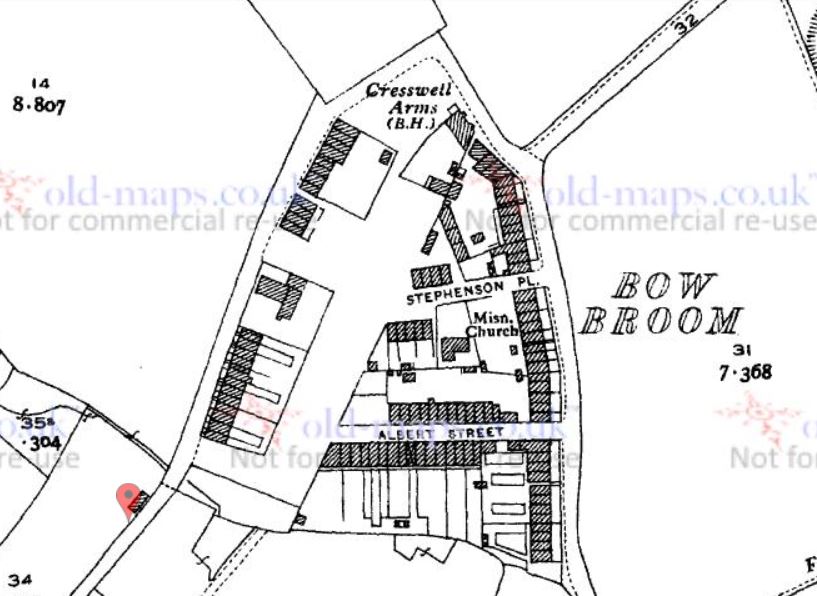
Snip from the 1930 Ordnance Survey map for Swinton showing Bow Broom
The road running top to bottom on the left is Thomas Street (from Old Maps)

This map snip shows the Bow Broom area of Swinton and the houses on Thomas Street. A later map includes the numbers and so I know that the lowest house shown here is number 40 and that the numbers run contiguously from north to south, not odds on one side and evens on the other.

I was able to find John and Ada in the 1881 census living at 8 William Street in Swinton. John was from Sunderland (which was an exciting moment as I was born in Sunderland!) and Ada was from Adwick, Yorkshire.  There is no record of them ever having married, which is no doubt the reason for their children being registered as Gibson Bailey.  Ada appears to have been a bit of a character appearing in court reports in the local newspapers in 1882 and 1886; on both occasions it was for fighting with another woman after a quarrel.  In the latter report Ada is Rotherham Workhouse, so we can assume that her children had been there from at least that date. There is no further sign of John Gibson but Ada Bailey married John Bloore in Q1 1891 (while her children were in the Workhouse!) and in the 1891 census return (5 April 1891) she is living with him at 16 Hicks Square, Glasshouse Road, Kilnhurst, near Rotherham and only two miles from Swinton. They already have one child, Harriet Ann aged 1 born in Kilnhurst. I am 100% certain this is the same woman as she gives her place of birth as Adwick and Harriet Ann's mother's maiden name is given as Bailey in her birth registration Q1 1890 in Rotherham RD.  I can find only one Ada Bailey of the right age born in 1862 in Adwick upon Dearne, to Charles and Emma Bailey.

Ada and John Bloor (also Bloore, Blower and Blewer) were living in Denaby Main at the time of the 1901 census by which time Sarah Ann, Polly and Mary had come along to join Harriett. Ada Bloor(e) continues to have an interesting life. She appears in the Mexborough and Swinton Times on 4 March 1905 accusing another woman of using obscene language towards her.

Obscene Language at Denaby Main
A lady who rejoices in the somewhat ill-fitting cognomen of Matilda Spruce, and who is described as a married woman, of Denaby, was summoned by another lady, by name Ada Bloore, for using obscene language towards her, on 21st February. The complainant stated that the defendant was always calling her filthy names, and that she wanted a stop putting to it. Defendant denied the insinuation that she used filthy language, stating that she was a respectable women. The Bench dismissed the case, whereupon the defendant, who only restrained her evident surprise and glee as "having won the day", with difficulty said: "Thank you sir, have I anything to pay?"  Upon being informed she could go, the defendant excitedly waved her "fur boa" in the air and exclaimed: "Three cheers", and merrily bounced out of court.

Despite her abandonment of her first three children in the workhouse (presumably after her desertion by John Gibson) I had hoped Ada found some happiness with John Bloor. Sadly it was not to be as he died in 1907 and by 1911 Ada is living with a John Hegin on Manningham Road in Attercliffe, Sheffield. This is definitely the right woman as the Hegins have Polly and Mary Blower living with them and Harriett Ann and Sarah Ann Blower are listed and then crossed out, all as step daughters - presumably because Ada gave her older girls names to the person who filled the schedule in for her (she signs with a x) before telling them that the two oldest were not living with her at that time.  Again I can find no sign of a marriage for Ada Bloor or Bailey to a John Hegin, but as the form was filled in by someone else and Ada was illiterate Hegin may be just as poor an intepretation of what was said at the time as Blower was for Bloor.

Having digressed to follow Ada around Yorkshire I must get back to Albert Gibson as he was the orignal object of this post.

In the 1918 Electoral Register an Albert Gibson is living at 39 Thomas Street in Swinton which is obviously very close to number 40, the address given in the newspaper article I first found. There are three other men at the address, Frank Arthur Waite, Leonard Hanking and William Abbott, although Abbott is marked as an Absent Voter in the Forces.  Albert is at the same address every year up to and including 1934, with various other occupants. In 1920 Grace Mary Abbott is listed there but no sign of  William Abbot, but Albert Gibson, Frank Arthur Waite, Leonard Hanking are there plus two other men. Grace Mary Abbott is still at 39 Thomas Street with Albert Gibson in 1934 and so is Frank Arthur Waite, now joined by Ethel Waite.  Albert would have been 50 years old by this time.

Section of 1939 Register for 39 Thomas Street, Swinton (from FMP)

Of course this turns out to have been all too simple ... at the same address in the 1939 Register I found Grace M Abbott apparently born 29 November 1852 and Albert Gibson born 22 November 1917!  There are two redacted names between these two people.  This cannot be the same Albert Gibson named in 1918 - he would have only been 1 year old!  And the birth day and month do not match that given in his workhouse baptism record. Is this a mistake? or his son? or a complete co-incidence?

1911 census for 40 Thomas Street, Swinton (edited to save space)

If Grace Abbott was indeed born in 1852 that made her 87 years old in 1939, which seemed a good age, so I thought I would investigate her.  Jackpot! In the 1911 census William and Grace Mary Abbott are living at 40 Thomas Street, Swinton, the very address Albert Gibson gives in the newspaper report in 1915. Grace Mary Abbott gives her age 57, which is within two years of the birth year of 1852 she reported in 1939. William and Grace say they had been married for 40 years and reported twelve (!) children to their marriage, of whom eight were still living in 1911. Only two of their children were still at home when the census was taken, but they also had two nephews living with them.

It seemed that despite the smallness of the house, with only four rooms declared, they managed to fit six people in somehow. This obviously continued for many years, but boarders/lodgers replaced children and nephews. An Albert Gibson appears to have lodged with them for many years, and Albert Gibson the soldier says he lived at 40 Thomas Street, but whether, over the years, it was the same man or two men with the same name, has not been demonstrated yet. 

One thing that may make sense is that the William Abbott who was an Absent Voter in the 1918 Electoral Register was probably the William Abbott jnr listed on the 1911 census as 13 years old.  I have mentioned before men aged 19 and over and in the Forces were also able to vote in 1918, so William jnr at 20 would have been listed.

For the sake of completness and with my fingers crossed I checked the 1901 census for Thomas Street. William and Grace Abbott are at 38 Thomas Street with five children. Grace gives her age as 48 years, that is born in 1852/3 in agreement with the 1939 Register.  William said he was 50 years old, but in 1911 he gave his age as 65.   That would have made him 72 years old in 1918, defintely too old to have been in the Services as an Absent Voter.

Remember this for later ... Jonathan Abbott aged 23 born in Normanton near Wakefield is living at 40 Thomas Street just two doors away.

It took a couple of looks for me to spot something strange ... in the 1901 census William and Grace's children are listed out of order and there is someone missing.  (in the lists below 'Do' means ditto)

William Abbott    Head    Married     M    50    
Grace M     Do     Wife    Married     F    48
Harriett       Do    Dau       Single        F    18
Sarah Jane    Do    Dau    Single        F    13
Albert         Do    Son      Single        M    19  (which has been over written in very heavy ink)
Hannah L    Do    Dau    Single        F    11
Edith L        Do    Dau    Single        F    8

I looked back at the 1891 census entry for the same family and found them at 38 Thomas Street in Swinton.

William Abbott    Head    Married    M    44
Grace     Do        Wife    Married    F    37
Thomas    Do       Son    Single    M    15
Jonathan    Do    Son    Single    M    13
Francis    Do        Dau    Single    F    10
Harriett    Do        Dau    Single    F    7
Grace        Do    Dau    Single    F    5
Sarah Jane    Do    Dau    Single    F    3
Amelia Eliza   Do    Dau    Single    F    1

Can you spot the difference?
(1) Where is Albert aged 9 in 1891?  If Albert is actually 10 in 1901 which would better fit the placing in the list, why has it been heavily written over as 19 to emphasise it?
(2) Where is William Abbott jnr in 1901, if he was 13 in 1911 he should be 3 in 1901?

I should comment on one of the girl's names - Amelia Eliza in 1891 becomes Hannah L in 1901 - that could just be transcription and enumerator error.

And look ... Jonathan Abbot who was living two doors away in 1901 is the right age to be their son shown as 13 in 1891 and ... both were born in Normanton. So by 1901 the Abbott family were occupying two houses, numbers 38 and 40.

I went back to check 1911.  The name of the person who filled in William and Grace's census form was Albert Edward Cook, he also filled in the census form for the house two doors away, where he appeared at the top of the schedule as 'Nephew' not the head of the household ... and this house was apparently also 40 Thomas Street!  A closer look suggests that actually William and Grace were living at number 38 according to the address information on the page following their return and number 40 was occupied by six men, four nephews and two boarders with, as we have noted, no head of household indicated. The name given on the address information was also W. Abbott. So the Abbott family was still occupying both houses and number 40 - the real number 40 was being used as a kind of lodging house.

Back to Albert ...
 
I hoped I wasn't on a wild goose chase ... but maybe William and Grace took Albert Gibson in as a lodger when he left the workhouse and the enumerator mistakenly listed him as their son in 1901. He wasn't have been living with them, in either house, in 1911, maybe because he had joined the army in 1903 and stayed on a bit longer than his seven years, but it seems to fit that in 1915 he gives the address of their second house, the lodging house, 40 Thomas Street as his home.

I needed to check William and Grace's children on the General Register Office (GRO) online index of births. I prefer to do this on the GRO because mother's maiden names are not recorded before 1911 on the FreeBMD or Ancestry indexes.

Let's take Harriett Abbott, she's in both census returns.
Born 1883 or 1884 in Bolton upon Dearne (which would be in the Doncaster RD)
Abbott, Harriet Robertson [mmn] Robertson
GRO Reference: 1883 J Quarter in Doncaster Volume 09C Page 722

Ok, now Sarah Jane Abbott, born 1888 in Swinton (which would be in the Rotherham RD)
Abbott, Sarah Jane [mmn] Robertson
GRO Reference: 1888 M Quarter in Rotherham Volume 09C 654

We have established that Grace Mary's maiden name was Robertson, and sure enough on FreeBMD I found the marriage of Grace Mary Robertson to William Abbott in the December Quarter (Q4) of 1872 in the Pontefract RD.  That makes Grace Mary Robertson 20 years old when she marries William, a very reasonable age.

Here's the crunch ... is there an Albert born to this family, surname Abbott mmn Robertson in either 1882 or 1891. This is what I found.

Tamar Howarth Abbott b.Q3 1872 in Pontefract
William Oath Abbott b. Q3 1874 in Pontefract
Thomas Robertson Hoult Abbott b.Q2 1876 in Pontefract
Jonathan Robertson Abbott b.Q2 1878 in Wakefield
Frances Tamar Abbott b.Q4 1880 in Barnsley Union
Harriet Robertson Abbott b.Q2 1883 in Doncaster
John William Abbott b.Q1 1885 in Rotherham
Grace Ann Abbott b.Q1 1886 in Rotherham
Sarah Jane Abbott b.Q1 1888 in Rotherham
Hannah Eliza Abbott b.Q2 1890 in Rotherham
Edith Elizabeth Abbott b.Q3 1893 in Rotherham

Eleven children born to William and Grace Mary Abbott - not the twelve they declare in 1911, but sometimes people counted miscarriages. No Albert! And no William Abbot jnr born in 1898.  We will never know for certain but it does look as if Albert Gibson could have been living with William and Grace Mary Abbott at 38 Thomas Street in 1901 and later in the other house they owned, the lodging house at 40 Thomas Street two doors away. 

When a stray child like William Abbott jnr turns up in the household of an older couple one common reason is that they have taken in a grandchild by a daughter to help her out. 

I haven't found deaths for Albert Gibson, or Ada Hugin/Bloor/Gibson/Bailey yet so their stories are not completely finished, but that is enough for today.  This has turned  into a mega post!

Thanks for reading.

References:
1939 Register, Find My Past, https://search.findmypast.co.uk/search-world-Records/1939-register, accessed 28 June 2020.
British Newspapers, Find My Past, https://search.findmypast.co.uk/search/british-newspapers, accessed 28 June 2020.
Commonwealth War Graves Commission, https://www.cwgc.org/, accessed 28 June 2020.
General Register Office, Online ordering service, https://www.gro.gov.uk/gro/content/certificates/Login.asp, accessed 28 June 2020.
Long, Long Trail, 'Enlisting into the army', https://www.longlongtrail.co.uk/soldiers/a-soldiers-life-1914-1918/enlisting-into-the-army/, accessed 28 June 2020.
Pension Records, Western Front Association, https://www.westernfrontassociation.com/ancestry-pension-records, accessed 28 June 2020.
Sheffield Soldiers of the Great War, http://sheffieldsoldierww1.co.uk/Home.html, accessed 28 June 2020.
UK, Soldiers Died in the Great War, Ancestry, https://www.ancestry.co.uk/search/collections/1543/, accessed 16 June 2020.

Tuesday, 16 June 2020

James and Albert Crawford First World War Soldiers from Concrete, Brampton

The section of the Brampton RoH showing James Crawford's name

I have been investigating the Brampton Roll of Honour which hangs in Brampton's Parish Hall since February this year. For briefness I will refer to it as the Brampton RoH or just the RoH.

There are 100 names listed on the RoH, 22 of these men (and they are all men) were killed in the First World War, the others survived to return home to their families.  I have found census data allowing me to establish who these men were and where they lived for 91 of these names and military information for 73, an increase of one since my last post. 

I have also begun to collect a list of men from the area covered by this memorial, ie the Concrete Cottages and Wath Junction, who served in the war but who were not listed on the RoH.  There were three additional names on the Cortonwood Wesleyan Methodist Roll of Honour (found online) which are not on the Brampton RoH, 29 more men were marked as Absent Voters in the 1918 Electoral Roll for Brampton or Wombwell South (the wards which include Concrete and the Junction and which available on Ancestry.co.uk) and three more have been found (so far) in the local newspaper, the Mexborough and Swinton Times (MST).

The Mexborough and Swinton Times was added to the British Newspaper Archive this month, June 2020 (also available on sister site Find My Past). It covers the southern part of Barnsley including Wombwell, Great Houghton, Thurnscoe (all within the modern Barnsley boundaries) plus Brampton, Wath, Swinton, Mexborough and Conisbrough. In the last two days, purely with a search on the word 'Concrete' I have added three more names to my research list, including one man from Concrete, George Clark, who was killed.

One odd thing about these additional names is that they include men who are the brothers of men who are listed on the Brampton RoH. We could suggest a couple of reasons for this, maybe they moved away from the area before the list was compiled? Possibly so, but many of the men listed on the RoH, despite living in Concrete earlier in their lives, were already living away from the area in 1911.  Maybe their families did not want them included - which is strange if one brother is listed but not another.

James and Albert's names on the Cortonwood Wesleyan RoH

For this post I am focusing on James (b.1896) and Albert (b.1891) Crawford, brothers who were both killed in the war. James Crawford is named on the Brampton RoH, Albert Crawford is not, but I had found him on the Cortonwood Wesleyan RoH alongside his brother.

They were living at home, 11 Wath Road, Wombwell Junction, with their parents James snr and Emily Crawford in 1911. Also listed on the census return is another brother, William (b.1893) and a sister Rose (b.1901). The return states that Emily has been married for 20 years and has had five children, one of whom had died before 1911. A search of the General Register Office (GRO) indexes tells us that Ann Crawford was born in 1895 and died the same year. These searches can be carried out in five year chunks using a surname and mother's maiden name. They are very useful for discovering the absent children that the 1911 census additional information tells us about. According to the census only Rose was born in Wombwell, the other children having all been born in Worsborough Dale.

James Crawford snr and Emily Pickard had married in Worsborough Dale (the second 'o' was lost from the area name in the early to mid 20th century), about five miles from Wath Junction, on 31 December 1890. James was originally from Thirsk, North Yorkshire and Emily from Otley, West Yorkshire (according to the 1901 and 1911 census returns), although in the 1891 census when James and Emily were living with her parents in Worsborough Dale, all her family (including James Crawford) are listed as being from Worsborough Dale itself.  This is an error as the 1881 census tells us that Emily's father William Pickard was from Otley, her mother Hannah from Darfield, Emily and Samuel, the older of three children, from Otley and Herbert, the youngest child, from Darfield. So the family moved around quite a bit, Otley being about 44 miles from Darfield.  It is always best to cross-check information found on a source as transcriptions or information given to the census enumerators or even to clergy for marriages, baptisms or burials can often be in error.

The Cortonwood Wesleyan RoH helpfully tells us that James was in the K.R.Rif., the King's Royal Rifle Corps, and gives us his Service number 467. This information tallies with his Service Records which have fortunately survived (60% of these records were destroyed in the blitz during the Second World War) and his entries on Soldiers Died in the Great War (SDGW) and the Commonwealth War Graves Commission (CWGC) website. He was killed on 18 June 1916 and his CWGC entry confirms that his father was James Crawford, of 11 Wath Road, Wombwell, Barnsley and that he was buried in the Cambrin Military Cemetery in France. His SDGW entry adds that he was killed in action and that he was born in Wombwell - which is therefore in disagreement with the 1911 census return. The information about his regiment reminded me of another memorial in Wombwell - the Church Lads Brigade memorial in St Mary's Church which was affiliated to the King's Royal Rifle Corps. Sure enough a Crawford, J. is listed there as well. He is also listed on the Wombwell Reform Club Members RoH in the Killed in Action section at the top alongside a Crawford, A. Pte. Y.L.

Two Crawford men named on the Wombwell Reform Club RoH

According to the Cortonwood Wesleyan RoH Albert was in the R.N. Lanc. Regt., Service number 31329. Tracing Albert's records was more complicated. His CWGC entry tells us that he was in the Loyal North Lancashire Regiment Service number 42151 (could someone have confused Loyal with Royal when preparing the Cortonwood RoH?) - this is the correct man as his parents are listed as Mr and Mrs J Crawford of 11 Wath Road, Wombwell. We also discover from this record that Albert was married, to a Mabel F. Crawford, and that her address at the time the CWGC information was collected was 4 Hough Lane, Wombwell. Bear in mind that the addresses for widows do not necessarily reflect the place where a soldier lived before he enlisted. Widows often moved after a man's death, maybe to return to their parents' home, or after re-marriage. Albert's SDGW entry adds that he was formerly in the York and Lancaster Regiment Service number 44591 and that he was born in Worsboro' Dale - which is correct according to the 1911 census return. He was killed on 4 November 1918 and was buried in the Mazinghien Communal Cemetery in France. Interestingly the additional documents on the CWGC page for Albert Crawford include a Graves Registration form which tell us that he was one of eleven Loyal North Lancs men killed on that day buried in that cemetery which suggests that a significant action had taken place (in my opinion). There seems to have been some confusion about his identity at some point as the type written entry reads 42151 Crawfers Pte.A. which is overwritten in ink, 44591 Crawford. Note that this is his Y&L Service number!

Graves Registration for Mazinghien Communal Cemetery CWGC

Now having the information that Albert had initially served in the York and Lancaster Regiment the Wombwell Reform Club entry makes sense.  Both James and Albert are also listed on the main Wombwell memorial outside St Mary's church - but as these names were renewed and updated in the last 10 or 20 years (see a photo from the 1930s on the Yococo website) it cannot be ruled out that they were added during the update.

Albert Crawford and Mabel Florence Hazzard had married on 23 May 1918 at Wombwell Parish Church and that record states his occupation is miner. So when did he join the Army? If it was after their marriage he was not long in the forces before he was killed. Barely enough time for initial training compared to the men who enlisted earlier in the war. After his death two death notices appear in the Mexborough and Swinton Times (MST) on 23 November 1918, one from Mabel and one which names his parents, James and Emily, giving their address at 11 Wath Road. Albert's photograph appears in the newspaper the following week, although it gives his regiment as the York and Lancaster, despite the death notice the week before more accurately reporting him in the Loyal North Lancs.

Albert and Mabel do not appear to have had any children. Mabel remarried in the September quarter of 1923 to Samuel Wardell (according to FreeBMD) and bore him two children, Albert in Q3 1924 and Mabel in Q4 1926. It is touching to see that her first child was named after her previous husband. In the 1939 Register the couple were living at 25 Cemetery Road in Wombwell with Albert and a redacted entry, probably young Mabel. In the comments column at the far right it was noted that Samuel was an Air Raid Warden.

Albert Crawford's Pension Card from the WFA website

So why was Albert not included on the Brampton RoH?  It could be that his wife Mabel did not know about the RoH or did not want him included. It could be that at the time of the compilation of the memorial there was some uncertainty about Albert's death.  However Albert's Pension Card (on the Western Front Association website and also available via Fold3 on Ancestry) states that his death was notified on 27 November 1918 which is not a long delay. This tallies with the date of the death notices published in the MST on 23 November.  On the Pension card Mabel's address has been changed from 4 Hough Lane, Wombwell (the address we saw above on the CWGC entry and the address from which she married in May 1918) to Laurel Dene, Lepton, Huddersfield so maybe she was living away from home for a while (there is no mention of her second marriage on the card). But why would his parents James snr and Emily omit him? It seems unlikely that a list of 100 men was compiled as soon as the Armistice was announced - and that the news of Albert's death came too late for him to be added. Could it be because he enlisted so late? Was the RoH compiled before his enlistment?

James and Albert are listed side by side on the Cortonwood Wesleyan Methodist RoH and the Wombwell Reform Club RoH but not on the Brampton RoH. And what happened to their brother William (b.1893), he was the right age to have served in the war and but I have found no military records for him yet. More questions that require further research if I am ever to understand this document.

William Crawford married Winifred Carr in Q3 1918 and I have found them in the 1939 register. They had two children, Albert b.1920 (another named after the Albert who died in the war?) and Joan b.1923. I have also found them in the 1939 register living in Hemingfield near Wombwell. William dies just two years later from the same address 16 Garden Grove, aged just 48. He predeceases his parents James snr, who dies in 1945 and Emily, who dies in 1948. They are buried in adjacent plots in Wombwell Cemetery. Sadly whilst searching in the Cemetery records I discovered that Rose Crawford who had married Lionel Hawksworth in Q1 1919 died in January 1922 and was buried from 11 Wath Road, her parents' home. This means that James snr and Emily outlived all their children.  The only consolation that I can find is that Rose gave birth to a daughter, Bessie, in 1920, who in 1939 is married and living with her widowed father and his mother in Wombwell. 

I have not yet confirmed which organisation compiled the Brampton RoH or when it was drawn up. It was apparently discovered in a poor state in the papers of a Brampton Parish Clerk as he handed over to a new incumbent very recently.  The discovery of the document was reported in October 2018 in the local parish council magazine where it was also noted that the former Parish Clerk had retired on 31 March 2018 after 32 years service!  So the RoH had been hidden away for many years.

Thank you for reading.

References:

1939 Register, Find My Past, https://search.findmypast.co.uk/search-world-Records/1939-register, accessed 16 June 2020.
British Army Service Records, Ancestry, https://www.ancestry.co.uk/search/collections/1219/, accessed 17 February 2020.
Census returns, Ancestry, https://www.ancestry.co.uk/search/categories/ukicen/, accessed various in February - June 2020.
Commonwealth War Graves Commission, https://www.cwgc.org/, accessed 16 June 2020.
Cortonwood Wesleyan Methodist Roll of Honour, My Methodist History, https://www.mymethodisthistory.org.uk/topics-2/war_memorials/a_further_204_late_returns/cortonwood, accessed 9 March 2020.
General Register Office, Online Ordering Service, https://www.gro.gov.uk/gro/content/certificates/login.asp, accessed 16 June 2020.
Mexborough and Swinton Times, British Newspaper Archive, https://www.britishnewspaperarchive.co.uk/titles/mexborough-&-swinton-times, accessed 15 June 2020.
Parish News, Issue 21, October 2018, Brampton Bierlow Parish Council, https://www.bramptonbierlow-pc.gov.uk/sites/default/files/pdf_docs/brampton_bierlow_oct_18_3_0.pdf, accessed 16 June 2020.
Parish Records for Worsborough Dale, Yorkshire Marriages, Find My Past, https://search.findmypast.co.uk/search-world-Records/yorkshire-marriages, accessed 16 June 2020.
Pension Records, Western Front Association, https://www.westernfrontassociation.com/ancestry-pension-records/, accessed 16 June 2020.
UK, Soldiers Died in the Great War, Ancestry, https://www.ancestry.co.uk/search/collections/1543/, accessed 16 June 2020.
West Yorkshire, England, Electoral Registers, 1840-1962, Ancestry, https://www.ancestry.co.uk/search/collections/3057/ accessed 22-28 May 2020.
Yococo Image Database, Barnsley Council Online, https://wwwapplications.barnsley.gov.uk/librarydigitisation/details.aspx?imageID=2755 accessed 16 June 2020.